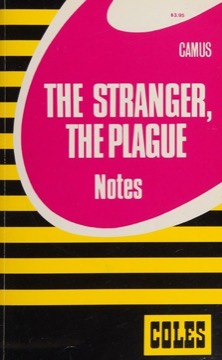
The Stranger
Albert Camus's 1942 novel about a man who does not grieve at his mother's funeral, kills a stranger on a beach, and is condemned more for the first than the second. The central text of absurdism.
- First published
- 1942
- Publisher
- Coles Publishing
- Pages
- 159
- Shelf
- Philosophy
- Level
- Core
- ISBN-13
- not established
Record checked against
Two sources agreed on 1942; a third reported differently (openlibrary 1980, wikidata 1942, wikipedia 1942).
Catalogue note
- Reads as
- ReflectiveChanges how you see rather than what you do.
- Level
- Core / BuildingAssumes general familiarity with the subject.
- Approach
- Theoretical
- Written for
- Reflective readers, Readers with some grounding
Saved in this browser only — no account, nothing sent anywhere. My library
Read this if
- You want to examine an assumption you have never examined.
- You read for the writing as much as for the argument.
- You want a book that changes how you see things rather than what you do tomorrow.
- You know roughly how the subject works and want the fuller account.
The premise
Meursault, a clerk in French Algiers, learns his mother has died. He attends the funeral without visible emotion, begins a relationship the next day, and some weeks later shoots a man on a beach.
The second half is his trial, in which the prosecution builds its case substantially on his behaviour at the funeral.
He is tried for a killing and convicted of not weeping.
Devmark’s reading — not a quotation from the book
The argument
Camus's absurd is the collision between a human demand for meaning and a universe that supplies none. Meursault's refusal to perform feelings he does not have makes him, in Camus's reading, honest in a society that requires the performance.
The trial dramatises this: what the court cannot forgive is the absence of the expected emotional script, which it treats as evidence of monstrosity.
The novel's charge is against a society that requires grief to be performed on schedule.
Devmark’s reading — not a quotation from the book
How it is written
The famous flat declarative style — short sentences, minimal subordination — enacts Meursault's refusal to impose narrative on events. Things happen and are reported; connections are not supplied.
The English title has been rendered as both The Stranger and The Outsider, and the difference matters: the French L'Étranger carries both, and Meursault is estranged as well as excluded.
What the novel does not examine
The man Meursault kills is an unnamed Arab, and the novel's colonial setting is the thing it is least curious about. This is now a central part of how the book is read.
Kamel Daoud's The Meursault Investigation (2013) rewrites it from the victim's brother's perspective and gives the dead man a name. Reading them together is the fuller version.
Two parts, two books
The novel divides exactly in half and the halves do different work. The first is Meursault living: the funeral, the beach, Marie, Raymond, the heat. The second is the same events retold by other people in a courtroom, where each becomes evidence of a character he does not recognise. Nothing is added in part two; everything is interpreted, and that is the point.
What he is actually tried for
The prosecution's case is built less on the killing than on the funeral — that he did not cry, that he smoked, that he began an affair the next day. Camus arranges it so the reader sees a man convicted for failing to perform grief, with the homicide functioning almost as the occasion. It is the novel's sharpest structural joke and its most serious claim about how societies actually judge.
He is not condemned for the killing. He is condemned for the funeral.
Devmark’s reading — not a quotation from the book
The chaplain
The only moment Meursault loses composure is with the prison chaplain, who insists he must believe in something. The outburst that follows is the novel's single passage of open argument, and it converts his passivity into a position: a refusal of consolation rather than an absence of feeling. Camus gives him the book's one lyrical paragraph here and nowhere else.
The translation problem
The famous first line turns on a word English does not have. Rendering it as "Mother" makes Meursault formal and cold from the outset; keeping the French preserves the childlike intimacy and changes the character the reader meets on page one. Later translations also restored the flat, clipped register of the original, which earlier versions had smoothed into more literary English. Which edition you read genuinely alters the book.
Its philosophical companion
Camus published a long essay on the absurd in the same period, and the two are usually read together: the novel dramatises what the essay argues. He also resisted being called an existentialist and disliked the label being attached to him, a distinction worth keeping given how routinely the novel is filed under it.
The reply it provoked
The novel's blindness to its Arab victim has since been answered from within literature rather than only from criticism: a later Algerian novel retells the events from the family of the murdered man, giving him the name and the life Camus withheld. Reading them together is now the standard way to teach the book, and it is a better response than either defending or discarding it.
What to take from it
It is short, it is deliberately affectless, and it rewards a second reading more than a first, because part two only becomes legible once you know what part one actually contained. Read it for the structure — the machinery by which an unremarkable man is assembled into a monster out of true facts — more than for the philosophy.
What to take away
- 01Condemned for not grievingThe trial turns on the funeral, not the killing.
- 02The absurdThe gap between wanting meaning and finding none is Camus's subject.
- 03Flat style as argumentShort declaratives refuse to impose narrative on events.
- 04Stranger or outsiderL'Étranger carries both; Meursault is estranged and excluded.
- 05The unnamed victimThe colonial blind spot is now central to reading the book.