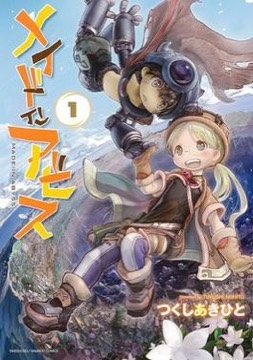
Made in Abyss
Akihito Tsukushi's series, begun in 2012, about children descending into an enormous pit whose depths inflict escalating physical penalties on anyone who climbs back up.
- First published
- 2012
- Publisher
- not established
- Pages
- not established
- Shelf
- Anime
- Level
- Core
- ISBN-13
- 9781626927735
Record checked against
No page count is recorded, so no reading estimate is shown for the book itself.
Catalogue note
- Reads as
- ReflectiveChanges how you see rather than what you do.
- Level
- Core / BuildingAssumes general familiarity with the subject.
- Approach
- Theoretical
- Written for
- Readers of comics, and anyone curious how the form works, Readers with some grounding
Saved in this browser only — no account, nothing sent anywhere. My library
Read this if
- You read for the writing as much as for the argument.
- You want a thought experiment you can live inside for a while.
- You care why some things are obvious to use and others are not.
- You want a book that changes how you see things rather than what you do tomorrow.
- You know roughly how the subject works and want the fuller account.
What it is
A town is built around the edge of the Abyss, a vast hole of unknown depth containing relics of extraordinary value and creatures nobody has catalogued. Descending is survivable; ascending inflicts a curse that worsens with depth.
Riko, a twelve-year-old apprentice, descends with a robot boy to find her mother, knowing that beyond a certain layer the journey is one-way.
Going down is free. Coming back is what costs, and past a certain point it is not survivable at all.
Devmark’s reading — not a quotation from the book
The curse as structure
Each layer has a defined ascension penalty — nausea, hallucination, haemorrhage, loss of humanity — and the rules are established early and applied without exception.
This is exceptional world-building. The one-way nature of the descent converts every decision into a commitment, and the tension comes from the map rather than from any antagonist.
Tsukushi's design
The creature and relic designs are extraordinary: strange, functional, biologically plausible in an unfamiliar way, and rendered with enormous detail.
The Abyss itself is drawn as a genuine ecosystem with vertical strata, and the world-building is delivered almost entirely through imagery rather than explanation. He has also produced extensive supplementary material about the Abyss's ecology, and the world plainly exists in considerably more detail than the narrative requires.
The tonal problem
The art style is soft and childlike, and the content includes mutilation, torture, bodily degradation and sustained suffering inflicted on children.
The contrast is deliberate and is the most divisive thing about the series. Some readers find it a powerful dissonance; others find it a poor excuse for the content.
Content warnings
The series contains graphic violence against children, nudity of child characters, urination and vomiting played for comedy, and an extended sequence of experimentation on children that is among the bleakest material in this section.
This is not incidental. Readers should decide in advance whether they want to read it, because the series will not moderate.
Layer five
The Idofront sequence, concerning a researcher who performed experiments on children in pursuit of a discovery, is the series' most famous and most distressing material.
It is also its best-constructed arc, and the argument about what a person will justify in pursuit of knowledge is made seriously rather than for shock.
Curiosity
The series' actual subject is the drive to know, and it is consistently sceptical: every character who descends does so because they must, and the cost falls on other people as often as on themselves.
The Abyss is a good image for a research programme that nobody can stop because the next layer is always there.
Riko and Reg
The two children are drawn as genuinely children — frightened, resourceful, frequently wrong — and the series does not make them capable beyond their years.
Riko's determination is treated as the same drive the series is criticising elsewhere, which is a more honest position than the adventure framing suggests.
Pace
It is slow, with long stretches of travel, camping and description, and volumes appear at long intervals.
The slowness serves the descent. The layers need to feel large, and the series spends the pages required to make the depth register. Tsukushi also draws it himself at a high level of detail, which accounts for the intervals and for the consistency of the world's texture.
Nanachi
A character introduced in the fourth volume, the product of the layer five experiments, becomes the series' emotional centre and its most beloved creation.
The arc that introduces them is where the series' ambitions and its unpleasantness are most tightly bound together. Their design is also among the series' most distinctive, and their speech pattern carries a substantial amount of characterisation on its own.
The adaptation
An animated series and films cover the material closely, including the difficult sequences, and are visually faithful to Tsukushi's designs.
The animation does not soften anything, which is worth knowing for readers considering it as an alternative route in. It is also structured across a television series and films, which makes the viewing order slightly awkward for someone approaching it new.
Who it is for
Readers who want exceptional world-building and can tolerate genuinely distressing content involving children.
It is ongoing and its reputation is genuinely divided. The imaginative achievement is real and so are the objections, and readers should take both seriously rather than choosing one. A reasonable approach is to read the first three volumes and decide there, since the fourth is where the series' true register becomes unavoidable.
What to take away
- 01A map that generates tensionDefined ascension penalties per layer make every descent a commitment, so the pressure comes from geography rather than an antagonist.
- 02Curiosity treated scepticallyThe drive to know is the real subject, and the series is consistent that its cost falls on other people.
- 03Dissonance or excuseThe childlike art against mutilation and torture is deliberate, and readers genuinely divide on whether it earns itself.
- 04Children drawn as childrenRiko and Reg are frightened, resourceful and frequently wrong, rather than capable beyond their years.
- 05World-building through imageryThe vertical ecosystem is delivered almost entirely through creature and relic design rather than explanation.
- 06Content that will not moderateExperimentation on children, graphic violence and sustained suffering are central, and readers should decide before starting.