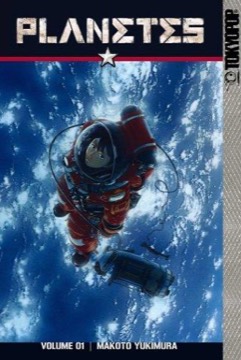
Planetes
Makoto Yukimura's series, begun in 1999, about a crew that collects orbital debris in 2075. Hard science fiction about unglamorous work.
- First published
- 1999
- Publisher
- Tokyopop
- Pages
- 197
- Shelf
- Anime
- Level
- Core
- ISBN-13
- 9781415506332
Record checked against
Catalogue note
- Reads as
- ReflectiveChanges how you see rather than what you do.
- Level
- Core / BuildingAssumes general familiarity with the subject.
- Approach
- Theoretical
- Written for
- Readers of comics, and anyone curious how the form works, Readers with some grounding
Saved in this browser only — no account, nothing sent anywhere. My library
Read this if
- You read for the writing as much as for the argument.
- You want a thought experiment you can live inside for a while.
- You are asking what you should be doing with your working life.
- You want a book that changes how you see things rather than what you do tomorrow.
- You know roughly how the subject works and want the fuller account.
What it is
In 2075, space is commercially exploited and crowded with debris, any piece of which can destroy a spacecraft at orbital velocity. A three-person crew works for a sanitation division collecting it.
Hachimaki wants his own ship; Fee wants somewhere to smoke; Yuri is looking for something specific lost in a collision years earlier.
Space, eventually, becomes somebody's job — and the job is picking up rubbish.
Devmark’s reading — not a quotation from the book
Work
The series' governing idea is that space will be occupied by ordinary employees doing unglamorous jobs for indifferent companies, and that debris collection is the least respected of them.
The realism is economic rather than technical. The crew's problems are budgets, contracts, promotion and being the division nobody wants to be seen with.
The science
Orbital mechanics, radiation exposure, the physical effects of long-term microgravity and the specific danger of small objects at high velocity are handled accurately.
The technical material is integrated into the plot rather than explained separately, and several major events turn on constraints the reader has already been shown.
Politics
A substantial portion concerns inequality between spacefaring nations and those excluded, and a terrorist organisation opposing the space programme is given a coherent and partially sympathetic argument.
The series refuses to treat space development as self-evidently good, and the political material is more serious than the premise suggests.
Hachimaki
His ambition curdles across the series into something obsessive and unpleasant, and he treats the people around him badly in pursuit of a berth on a Jupiter mission.
The series lets him be genuinely unlikeable for a long stretch, and his recovery is slow and incomplete.
Isolation
Long sections concern what extended time in space does to people psychologically: the compression of social contact, the loss of proportion, and a particular kind of religious feeling.
Yukimura's treatment of this is the series' best material, and it is handled without either mysticism or dismissal.
Fee and Yuri
The other two crew members are given full arcs — Fee's frustration at smoking restrictions becomes a genuinely good story about persistence, and Yuri's grief is the series' quietest thread.
The supporting characters are as developed as the protagonist, and the crew dynamic is the reason the early volumes work.
The art
Clean, detailed and technically confident, with hardware drawn plausibly and a good sense of the physical awkwardness of working in a suit.
Yukimura's drawing here is less assured than in Vinland Saga, which followed, and the improvement between the two is substantial. The suits in particular are drawn with attention to how badly they restrict movement, which is a detail most space fiction ignores entirely.
Length
Four volumes, complete, which is unusually short and makes it one of the easiest recommendations in this section.
The brevity also means the political material is compressed, and the final volume moves considerably faster than the first two. Yukimura has said he ended it deliberately rather than continuing, and the compression in the final volume is the visible cost of that decision.
Tone
The early chapters are comic and episodic; the later volumes are philosophical and considerably heavier, concerning love, meaning and whether ambition is worth what it costs.
The shift is noticeable and not entirely smooth, and readers who came for the workplace comedy sometimes find the ending register unexpected.
The adaptation
A 2003 animated series expands the material substantially, adding episodes and restructuring the political plot, and is generally considered excellent.
It is one of the rare cases where the adaptation is longer and more developed than the source, and both are worth having. The anime also gives Fee and Yuri considerably more room, and several of its best episodes concern characters who barely appear in the manga.
Who it is for
Readers who want science fiction about labour rather than about exploration, and who value accuracy without wanting a technical manual.
It is short, complete and among the best hard science fiction in the medium. It requires no background and is a reasonable first manga for readers arriving from written science fiction.
What to take away
- 01Space as somebody's jobThe premise is that orbit will be occupied by ordinary employees doing unglamorous work for indifferent companies.
- 02Economic rather than technical realismThe crew's problems are budgets, contracts and low status rather than equipment failures.
- 03Development not assumed goodA terrorist group opposing the space programme is given a coherent and partially sympathetic case.
- 04A protagonist allowed to be unpleasantHachimaki's ambition makes him genuinely bad to the people around him, and his recovery is slow and partial.
- 05Isolation taken seriouslyExtended time in space produces loss of proportion and a specific religious feeling, handled without mysticism or dismissal.
- 06Constraints established then usedOrbital mechanics and radiation are shown early and several major events turn on them later.