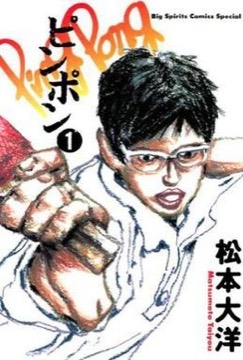
Ping Pong
Taiyo Matsumoto's series, published 1996 to 1997, about two friends on a high-school table tennis team. Sports manga as a study of talent and its absence.
- First published
- 1996
- Publisher
- Delcourt
- Pages
- 202
- Shelf
- Anime
- Level
- Core
- ISBN-13
- 9782847892703
Record checked against
Catalogue note
- Reads as
- ReflectiveChanges how you see rather than what you do.
- Level
- Core / BuildingAssumes general familiarity with the subject.
- Approach
- Theoretical
- Written for
- Readers of comics, and anyone curious how the form works, Readers with some grounding
Saved in this browser only — no account, nothing sent anywhere. My library
Read this if
- You read for the writing as much as for the argument.
- You want to be kept up late, and made uneasy about who to believe.
- You want a book that changes how you see things rather than what you do tomorrow.
- You know roughly how the subject works and want the fuller account.
What it is
Peco and Smile have played table tennis together since childhood. Peco is loud, arrogant and gifted; Smile is withdrawn and, according to their coach, considerably more talented but unwilling to win.
The series follows them and three rivals through a regional tournament, and is less about the outcome than about what each player wants from the game.
One of them loves the game and cannot win. The other can win and does not care.
Devmark’s reading — not a quotation from the book
Talent
The series' actual subject is the distribution of ability and what it does to people: those who have it and squander it, those who work and remain insufficient, and those who are good enough to know they will never be great.
Every one of the five central players has a different relationship to this, and none of the answers is presented as correct.
Smile
He is emotionally withdrawn to the point of absence, plays without visible pleasure, and has been protecting Peco by losing to him since they were children.
His arc toward wanting to win is the series' spine, and it is written as a recovery rather than as an improvement.
Matsumoto's drawing
Loose, distorted, aggressively unconventional, with warped perspective, scratchy linework and figures that stretch and compress according to movement.
It is among the most distinctive styles in the medium and is divisive: it reads as either extraordinarily kinetic or as simply ugly, depending on the reader.
Motion
The table tennis is rendered through distortion rather than through accuracy: a swing may occupy a full page as a blur, and a rally may be drawn as a sequence of impossible postures.
The approach conveys speed and strain better than a realistic style would, and the sport sequences are among the best action drawing in this section.
The rivals
Dragon, Akuma and Kong each embody a different position — discipline without joy, effort without talent, ambition displaced by circumstance — and each is given real interiority.
The series is unusually generous to the players who lose, and several of its strongest passages belong to characters who are eliminated.
Length
Five volumes, which is very short, and the series is correspondingly concentrated with no digression at all.
The brevity is a substantial part of its quality. The material is exactly as long as it needs to be, which distinguishes it sharply from most sports manga.
The hero framing
Peco casts himself as a hero throughout, in language borrowed from comics, and the series takes that self-mythologising seriously rather than mocking it.
The eventual question is whether anyone can be a hero to someone else, and the answer it gives is modest and specific.
Tone
It is bleak in places and genuinely warm in others, and the emotional register is much closer to literary fiction than to the sports genre's usual encouragement.
Nothing is resolved by trying harder, and several characters end in situations they did not want and cannot change.
Matsumoto's other work
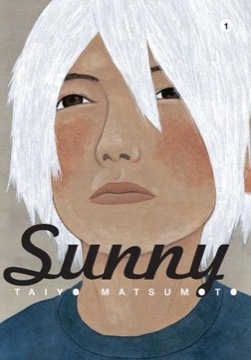
Tekkonkinkreet and Sunny share the same formal restlessness applied to street children and to a children's home respectively.
He is among the medium's genuine stylists, and readers who respond to the drawing here should certainly continue to the others. He has also collaborated on animation and picture books, and his work has been exhibited as fine art, which is unusual for a manga author of his generation.
The adaptation
A 2014 animated series by Masaaki Yuasa preserves the distortion and is widely considered one of the best adaptations in the medium, with a visual approach as unconventional as the source.
It is a rare case where the animation does not normalise a difficult style, and either version is a legitimate way in.
Who it is for
Readers who want sports fiction about failure and ability rather than about victory, and who can accept extremely unconventional drawing.
It is short, complete and among the best things in this section. Readers put off by the art in the first few pages should give it a volume, since the style's logic becomes apparent in motion.
What to take away
- 01Talent distributed unevenlyFive players each have a different relationship to ability, and none of their answers is presented as the correct one.
- 02Losing as protectionSmile has been throwing games to shield his friend since childhood, and wanting to win is written as recovery.
- 03Distortion conveying speedWarped perspective and impossible postures render table tennis better than accuracy could.
- 04Generous to the eliminatedSeveral of the strongest passages belong to players who lose and do not return.
- 05Self-mythologising taken seriouslyPeco's hero language is borrowed from comics and the series engages with it rather than mocking it.
- 06Exactly as long as it needsFive volumes with no digression, which distinguishes it sharply from the sports genre's usual sprawl.