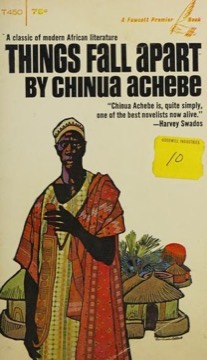
Things Fall Apart
Chinua Achebe's novel of Okonkwo, a leader in an Igbo community in what became Nigeria, and of what happened when missionaries and colonial administration arrived — written to give the encounter an African account.
- First published
- 1958
- Publisher
- Heinemann
- Pages
- 192
- Shelf
- Fiction
- Level
- Core
- ISBN-13
- 9780385474542
Record checked against
Catalogue note
- Reads as
- ReflectiveChanges how you see rather than what you do.
- Level
- Core / BuildingAssumes general familiarity with the subject.
- Approach
- Theoretical
- Written for
- Readers of literature, Readers with some grounding
Saved in this browser only — no account, nothing sent anywhere. My library
Read this if
- You read for the writing as much as for the argument.
- You want to think harder about what is actually right.
- You want a book that changes how you see things rather than what you do tomorrow.
- You know roughly how the subject works and want the fuller account.
Why it was written
Achebe has described reading European novels set in Africa — particularly Joyce Cary's *Mister Johnson* — and recognising that Africans appeared in them as scenery rather than as people with interior lives.
The novel is a direct response. Two thirds of it takes place before any European appears, establishing a functioning society with its own institutions, disputes, religion and internal critics, so that what follows happens to something rather than to a blank.
Two thirds of it happens before any European appears, which is the structural argument the book is making.
Devmark’s reading — not a quotation from the book
Okonkwo
A wrestler and a successful man who has built his position in deliberate opposition to his father, whom he regarded as idle and weak.
His driving fear is of being thought weak, and it makes him rigid, violent toward his family, and unable to adapt. Achebe does not present him as admirable — the community repeatedly judges his excesses — and the novel's tragedy is that the qualities that made him successful are the ones that destroy him.
Umuofia
The society is depicted in detail: the kinship structures, the oracle, the egwugwu masked judges, the yam economy, the seasonal festivals, the system for resolving disputes between villages.
Achebe includes what is admirable and what is harsh — the treatment of twins, the osu caste, the killing of Ikemefuna — without softening either. The community is presented as a real place with real injustices rather than as a lost idyll.
Ikemefuna
The boy given to the village in settlement of a dispute, who lives in Okonkwo's household for three years, comes to regard him as a father, and is killed on the oracle's instruction.
Okonkwo participates in the killing despite being advised not to, because he fears appearing weak. It is the novel's pivotal act and the source of everything that follows in his life.
The arrival
The missionaries come first and are given land in the evil forest, which they survive, undermining the community's account of the world.
Achebe's treatment of who converts is the sharpest political observation in the book: the first converts are the marginalised — the osu, mothers of twins, people with no title — for whom the new religion offers a status the old one denied them.
The first converts are the people the existing order had already excluded. That is the opening the mission uses.
Devmark’s reading — not a quotation from the book
Two missionaries
Mr Brown, who learns about Igbo religion, argues respectfully and builds a school; and his successor Mr Smith, who sees only darkness and forbids accommodation.
The distinction matters to Achebe's argument. The damage is not only a matter of individual cruelty, and even the respectful version was engaged in dismantling a society — but the shift from one to the other is what makes conflict unavoidable.
The ending and the last paragraph
The novel closes by shifting into the perspective of the District Commissioner, who is contemplating the book he will write and considers that the events might make a reasonable paragraph in it.
The whole novel is the answer to that paragraph. A life the reader has spent two hundred pages inside is reduced to an anecdote in an administrator's manuscript, and the compression is the point.
Language
Achebe wrote in English and defended the choice against critics who argued African literature should be in African languages.
His position was that English could be made to carry Igbo thought if it was altered to do so, and the prose is full of proverbs, oral rhythms and untranslated terms. The argument with Ngũgĩ wa Thiong'o, who took the opposite view and stopped writing novels in English, is one of the significant debates in African literature.
What it is not
It is not a defence of the pre-colonial order as ideal. The novel's internal critics — Obierika questioning the customs, Nwoye rejecting them — are given serious weight.
Nor is it a simple anti-colonial polemic. The damage is shown as partly enabled by fractures the society already had, which is a harder and more honest argument.
Its position
It is the most widely read African novel, translated into a great many languages, and it effectively founded modern African literature in English as a field.
Achebe's essay attacking *Heart of Darkness* for its treatment of Africans is the companion text, and reading the two together shows exactly what this novel was constructed to answer.
What to take away
- 01The society is built before it is brokenTwo thirds of the novel establishes a functioning world so the arrival happens to something.
- 02Okonkwo's strength is his flawThe fear of seeming weak that built his position is what makes him unable to adapt.
- 03The excluded convert firstThe new religion offered status to exactly the people the old order had denied it.
- 04The last paragraph is the argumentTwo hundred pages of interior life reduced to an anecdote in an administrator's book.
- 05It criticises both ordersThe internal critics are taken seriously, and the fractures were there before the missionaries used them.