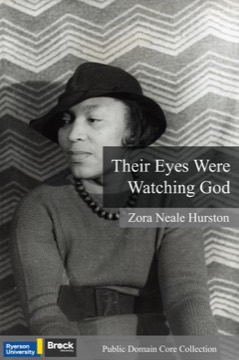
Their Eyes Were Watching God
Zora Neale Hurston's 1937 novel about Janie Crawford, told to a friend on a porch after she comes back to town alone. Three marriages, one life, and a woman working out what she wants instead of what she is for.
- First published
- 1937
- Publisher
- Perfection Learning Prebound
- Pages
- 231
- Shelf
- Fiction
- Level
- Core
- ISBN-13
- 9781983254246
Record checked against
Catalogue note
- Reads as
- ReflectiveChanges how you see rather than what you do.
- Level
- Core / BuildingAssumes general familiarity with the subject.
- Approach
- Theoretical
- Written for
- Readers of literature, Readers with some grounding
Saved in this browser only — no account, nothing sent anywhere. My library
Read this if
- You read for the writing as much as for the argument.
- You want a book that changes how you see things rather than what you do tomorrow.
- You know roughly how the subject works and want the fuller account.
The premise
Janie returns to Eatonville — a real all-Black town in Florida — in overalls, alone, with the town assuming the worst. She tells her friend Pheoby the whole story, and the novel is that telling.
It runs through a marriage arranged by her grandmother for security, a second to an ambitious man who becomes mayor and requires her silence, and a third to a younger man called Tea Cake with whom she works the fields and is, for a time, an equal.
The book's question is not who Janie marries. It is when she is permitted to speak.
Devmark’s reading — not a quotation from the book
How it is built
Hurston, who was a trained anthropologist, writes the dialogue in Black Southern vernacular and the narration in a lyrical literary register. The two voices together are the novel's signature and were the main thing contemporaries argued about.
The frame matters: Janie is telling this, to a woman, on her own terms, having already survived it. The structure hands her the authority the marriages kept taking away.
Hurston gives Janie the last word by making the entire novel her account.
Devmark’s reading — not a quotation from the book
Reception and recovery
The novel was criticised at publication by Richard Wright and others for not being a protest novel, and Hurston died in obscurity. Alice Walker's 1975 essay "In Search of Zora Neale Hurston" led directly to its recovery.
It is now read as a foundational text of Black American literature and of Black women's writing in particular — a book about interior life at a moment when Black writers were expected to write about oppression from the outside.
Told to a friend
Janie returns to town and tells her story to one woman on a porch, and the whole novel sits inside that telling. The frame matters: this is a woman choosing her audience after a lifetime of being talked about by people who were not listening, and the community's gossip is present on the first page as the thing she is answering.
The town has been talking about her for years. The book is her deciding who actually gets told.
Devmark’s reading — not a quotation from the book
Three marriages
The structure is three relationships that are not a progression toward a prize but an education: the first arranged for security, the second for status under a man who needs her silent, the third chosen freely and on her own terms. Each teaches something the next requires.
The pear tree
The adolescent image of a blossoming tree and a bee is Janie's standard for what she is looking for, and the novel keeps returning to it as a measure. Hurston uses it to give her heroine a criterion of her own rather than one supplied by the people arranging her life.
Two Englishes
The narration is lyrical and literary while the dialogue is rendered in a closely observed Florida vernacular, and Hurston holds the two registers apart deliberately throughout. She was a trained anthropologist who had spent years collecting folklore across the South, so the speech on the page is field-accurate rather than approximated from the outside — which is precisely what several prominent contemporaries objected to most loudly.
The hurricane
The late storm sequence is the novel's great set piece and the source of its title: people watching a sky they cannot read, waiting on something with no interest in them. It also forces the decision the last section turns on, and it is where Hurston's prose is at its most powerful.
Why it disappeared
Prominent contemporaries attacked it for not addressing racial politics directly and for what they read as caricature in its dialect. It went out of print, Hurston died in poverty, and it was recovered decades later largely through the advocacy of a later novelist — a rehabilitation now as famous as the original reception.
The trial
The book ends with a legal proceeding in which Janie is judged by a courtroom of strangers while the people who know her are present and not permitted to matter. It is the final statement of the novel's subject: who is allowed to narrate a woman's life, and to whom.
What to take away
- 01Two registersVernacular dialogue against lyrical narration; the combination was the controversy and the achievement.
- 02The frame is the argumentJanie narrates her own life to a friend, which is the authority the book is about.
- 03Three marriages, three silencesEach relationship is measured by how much she is allowed to say.
- 04The horizonHurston's image of a life as a ship on the horizon opens and closes the book.
- 05Lost and recoveredDismissed in 1937, rediscovered through Alice Walker in the 1970s.