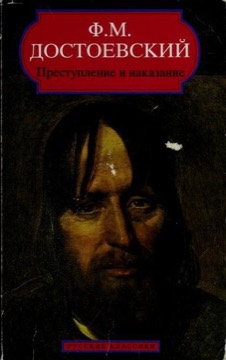
Crime and Punishment
Dostoevsky's 1866 novel of a destitute former student in St Petersburg who convinces himself that an extraordinary man is permitted to transgress ordinary morality — and of what happens to that theory once it meets the person holding it.
- First published
- 1866
- Publisher
- The Russian Messenger'' (series)
- Pages
- 520
- Shelf
- Fiction
- Level
- Deep
- ISBN-13
- 9783492204019
Record checked against
Catalogue note
- Reads as
- ReflectiveChanges how you see rather than what you do.
- Level
- Advanced / AdvancedAssumes you have read around the subject already.
- Approach
- Theoretical
- Written for
- Readers of literature, Specialists and serious readers
Saved in this browser only — no account, nothing sent anywhere. My library
Read this if
- You read for the writing as much as for the argument.
- You want evidence about why people behave as they do, not folklore.
- You want a book that changes how you see things rather than what you do tomorrow.
- You have read around this already and want a book that assumes it.
The premise
Raskolnikov, a former student living in extreme poverty in a cramped St Petersburg garret, has developed a theory about who is permitted to break the law. The first part of the novel takes him to the point of testing it.
Almost everything the book is interested in happens afterwards, and the crime is disclosed early rather than withheld. It is not a mystery; the reader knows. What is unknown is what the knowledge will do to him.
The theory, and why it matters
Raskolnikov's argument, set out in an article he wrote, divides humanity into ordinary people who must obey and extraordinary people who may transgress if their idea requires it.
Dostoevsky is writing against a specific intellectual current of the 1860s — rational egoism and utilitarian reform — and the theory is constructed to be genuinely tempting rather than obviously monstrous. The novel's method is to grant the argument its full force and then let it be inhabited.
The novel does not refute the theory. It lets a man live inside it and reports what that is like.
Devmark’s reading — not a quotation from the book
Psychology before psychology
The book's enduring achievement is the rendering of a mind under sustained strain: fever, paranoia, compulsive self-justification, the urge toward confession fighting the urge toward concealment.
Dostoevsky is writing decades before clinical vocabulary existed for any of it, and the interior sections remain among the most convincing accounts of psychological deterioration in fiction. The physical setting — heat, stairs, crowded rooms, the yellow of the wallpaper — is used as an extension of the mental state throughout.
Porfiry Petrovich
The investigating magistrate is one of literature's great creations and the source of the novel's central tension. He has no evidence, and he is certain.
His method is conversational: he never accuses, he theorises aloud, he leaves silences. The extended interviews between the two are a battle of psychology rather than procedure, and they are the most gripping thing in the book.
Suffering and the possibility of return
Dostoevsky's moral architecture runs through the idea that suffering is not merely punishment but the route back — and Sonya, whose own circumstances are desperate, is the character who carries it.
Modern readers frequently find this the hardest part of the novel. The Christian frame is not decorative; the book's resolution depends on it, and a reading that discards it has to account for the ending some other way.
Poverty as a cause, not a background
The St Petersburg of the novel is oppressive and specific: heat, stench, crowding, debt, the routine humiliation of having no money. Dostoevsky is explicit that the conditions shape the thinking.
This complicates any simple moral reading. The novel neither excuses Raskolnikov nor pretends his circumstances are irrelevant, and it takes seriously the idea that a society can produce the reasoning it then punishes.
The other plots
Around the central line sit several substantial subplots — his sister's proposed marriage, Marmeladov's family, and Svidrigailov, whose presence functions as a demonstration of what the theory looks like in someone who feels nothing about it at all.
Svidrigailov is the novel's most disturbing figure precisely because he is the argument without the anguish, and his trajectory is the clearest thing Dostoevsky says about where the theory leads.
Translation, again
As with most Russian classics, the translation substantially determines the experience. Constance Garnett's older versions are smoother and more Victorian; Pevear and Volokhonsky's are closer to Dostoevsky's deliberately rough, repetitive, sometimes clumsy Russian.
Dostoevsky wrote quickly and under financial pressure, and the prose is not elegant. Translations that smooth it out are making an editorial choice worth knowing about before you pick one.
How it reads
Long, feverish, and structurally uneven — Dostoevsky was serialising under deadline, and it shows in places. There are lengthy digressions and characters who arrive to deliver a position.
It is also far more propulsive than its reputation suggests. The middle section, once Porfiry is engaged, reads like a thriller, and readers who expect difficulty are often surprised by how fast it moves.
Why it endures
Because the question it asks has not been retired: whether an idea can license what would otherwise be forbidden, and what happens to the person who acts on one.
The twentieth century supplied a great deal of evidence on that question, and the novel anticipated the shape of it — which is why it reads less like a period piece than almost anything else written in the 1860s.
What to take away
- 01Inhabit the argument, do not refute itThe theory is given full force and then lived in, which is more damaging to it than any rebuttal.
- 02The crime is early on purposeThis is not a mystery. The subject is what knowing does to the person who knows.
- 03Conditions produce the reasoningThe novel refuses both to excuse and to treat the poverty as mere background.
- 04Svidrigailov is the control caseThe same theory without the anguish, which is what shows where it actually leads.
- 05The Christian frame is structuralThe resolution depends on it; a reading that discards it must account for the ending some other way.