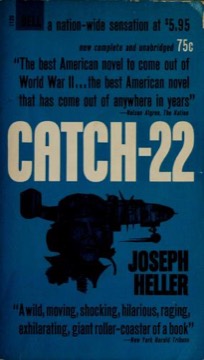
Catch-22
Joseph Heller's 1961 novel about a bombardier on a Mediterranean island trying to be declared insane so he can stop flying missions, and the regulation that makes this impossible.
- First published
- 1961
- Publisher
- VINTAGE (RAND)
- Pages
- 463
- Shelf
- Fiction
- Level
- Core
- ISBN-13
- 9789146215301
Record checked against
Catalogue note
- Reads as
- ReflectiveChanges how you see rather than what you do.
- Level
- Core / BuildingAssumes general familiarity with the subject.
- Approach
- Theoretical
- Written for
- Readers of literature, Readers with some grounding
Saved in this browser only — no account, nothing sent anywhere. My library
Read this if
- You read for the writing as much as for the argument.
- You want to understand how power is taken, kept and lost.
- You want a book that changes how you see things rather than what you do tomorrow.
- You know roughly how the subject works and want the fuller account.
The premise
Yossarian flies bombing runs from Pianosa and wants to stop. The only exit is a psychiatric discharge. But a man who asks to be grounded on grounds of insanity has demonstrated a rational concern for his own safety and is therefore sane.
That is Catch-22. The rest of the novel extends the same logic outward until it covers the entire institution.
Asking to be excused proves you are sane enough to continue, which is the whole machine in one sentence.
Devmark’s reading — not a quotation from the book
How it is built
The chronology is deliberately scrambled and repetitive: events are mentioned, returned to, and slowly filled in, so that a scene which first appears as a joke becomes unbearable by its fourth appearance.
Snowden's death is the clearest example. It is referred to throughout and described in full only near the end, and the comedy of the preceding four hundred pages reads differently afterwards.
The book tells you the same joke four times, and by the last one it is not a joke.
Devmark’s reading — not a quotation from the book
The satire
Heller's target is not war exactly but bureaucratic self-interest: Milo Minderbinder's syndicate, which ends by contracting to bomb his own squadron at a profit, is the book's thesis.
It was published in 1961 and read against Vietnam rather than the Second World War, which is much of why it became the defining novel of institutional absurdity.
Reading it
The first hundred pages are disorienting by design — repetitive, circular, with a large cast introduced without hierarchy. Readers who push through generally find the structure clicks.
It is very funny and then it is not, and the transition is engineered rather than accidental.
Heller took eight years to write it and the labour is visible in the construction — the repetitions are load-bearing rather than loose, and almost every apparently throwaway detail returns.
The catch itself
The rule is that a man is grounded if he is insane, but must ask to be grounded, and anyone who asks has demonstrated a rational fear of death and is therefore sane. Heller's invention is a piece of logic that is perfectly valid and entirely inescapable, and it entered the language because it describes something people recognised without having had a name for it.
The rule is logically airtight. That is exactly what makes it impossible to escape.
Devmark’s reading — not a quotation from the book
The chronology
Events are told out of order and repeated from different angles, with the same scene returning several times and gaining a new detail on each pass. One death in particular is circled for the whole novel before it is finally described in full, and the deferral is the book's structural spine rather than a stylistic game.
Milo
The mess officer who builds a syndicate, trades with the enemy, contracts to bomb his own squadron and explains that everybody has a share is the book's most durable satire. Heller's target is not corruption but the moral logic of enterprise itself, applied consistently in a setting where it produces absurdity.
The missions keep rising
The specific grievance driving the plot is administrative: the number of missions required before rotation home is raised repeatedly, always just before men reach it. The war is not the antagonist. The bureaucracy that will not let anyone finish is, and it is run by officers pursuing promotion.
It turns serious
The last third abandons comedy almost entirely. A long sequence through a ruined city, the treatment of a young woman, and the full account of the death deferred all along are written straight, and the earlier jokes look different afterwards. Readers who stop at the farce have read half a book.
Its reception
It sold modestly in America on publication in 1961 and was received far better in Britain, becoming a defining text only as the Vietnam war progressed. Its title is now used daily by people who have not read it, generally with reasonable accuracy about what it means.
What to take away
- 01The catchWanting out proves you are fit to stay in.
- 02Scrambled chronologyEvents revisited until the comedy curdles.
- 03SnowdenWithheld until the end, and it recolours everything before it.
- 04Milo's syndicateBureaucratic self-interest bombing its own side at a profit.
- 05Read against VietnamPublished in 1961 and adopted by a later war's readers.