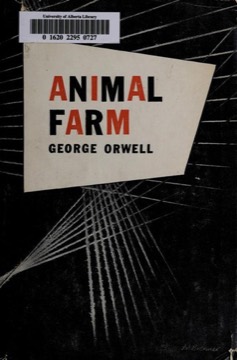
Animal Farm
George Orwell's short allegory of a farm taken over by its animals — a fable that tracks a revolution from its founding principles to their inversion, written as a direct attack on Stalin's Soviet Union.
- First published
- 1945
- Publisher
- Nāṣanal Bukk St̲āḷ
- Pages
- 128
- Shelf
- Fiction
- Level
- Entry
- ISBN-13
- 9783526275244
Record checked against
Catalogue note
- Reads as
- ReflectiveChanges how you see rather than what you do.
- Level
- Accessible / FoundationalNo prior reading assumed.
- Approach
- Theoretical
- Written for
- Readers of literature, Newcomers to the subject
Saved in this browser only — no account, nothing sent anywhere. My library
Read this if
- You read for the writing as much as for the argument.
- You want to understand how power is taken, kept and lost.
- You want a book that changes how you see things rather than what you do tomorrow.
- You are starting from scratch here and want a way in that assumes no prior reading.
What it is
A beast fable of about a hundred pages, written in deliberately plain prose and structured so that a reader who knows nothing of Soviet history can follow it as a story about animals.
Orwell called it a fairy story on the title page. The form was chosen because a fable states its argument through events rather than through commentary, and because an animal cast makes the pattern visible without the distraction of national detail.
The fable form states the argument through events. The animal cast makes the pattern visible without national detail.
Devmark’s reading — not a quotation from the book
The allegory
The correspondences are close and were meant to be recognised: Old Major, the revolution, the two pigs who lead it and the one who drives the other out, the secret police, the show trials, the neighbouring farms.
Orwell was not writing a general fable about power that happens to resemble the Soviet Union. He was writing about a specific betrayal by a specific regime, and the general application came afterward.
The commandments
The novel's central device: seven principles painted on the barn wall, altered progressively as circumstances require, with each alteration presented as what the animals had always understood.
The mechanism is the book's real subject. Nobody announces a change of principle; the wall is simply repainted, and the animals who half-remember otherwise doubt their own memory rather than the wall.
Squealer
The pig who explains. Every reversal is accompanied by a justification that appeals to the animals' fear of what returning to the old order would mean, and by statistics demonstrating improvement that nobody can check.
He is the most contemporary figure in the book. His method — reframing, selective figures, the implied threat of the alternative — does not depend on the historical setting at all.
Reframing, unverifiable figures and the implied threat of the alternative. That method has not aged.
Devmark’s reading — not a quotation from the book
Boxer
The cart-horse whose answers to every difficulty are to work harder and to trust the leadership, and whose fate is the book's harshest moment.
Orwell's treatment of him is the emotional centre and the political point: the regime's most loyal and productive supporter is disposed of the moment he stops being useful, and the disposal is explained to everyone else as something else.
The ending
The final scene, in which the ruling pigs and the human farmers play cards together and the watching animals can no longer distinguish one from the other.
It is the argument in a single image: the revolution has not been betrayed by an external enemy but has arrived at the thing it replaced.
How it was received
Publishers declined it during the war, when the Soviet Union was an ally and criticism was politically awkward. Orwell wrote a preface on press freedom, unpublished at the time, about exactly this.
It was then adopted during the Cold War as anti-communist material, which Orwell would have regarded as only half right — he was a socialist attacking a regime he considered a betrayal of socialism, not an opponent of the idea.
What Orwell actually thought
He is explicit in his essays: he wrote against totalitarianism and for democratic socialism, and he regarded the Soviet myth as the main obstacle to the second.
This matters for reading the book. Its target is the capture of a movement by a class that installs itself as the new elite, which is a claim about mechanism rather than about ideology.
Its limitations
It is schematic by design, and the allegory's tightness means the characters are positions rather than people. Readers wanting psychological depth are reading the wrong book.
The allegory also encourages a simple reading of a complicated history, and students taught it as an account of the Russian Revolution learn the shape of the argument rather than the events.
Why it lasts
Because the mechanisms it names — the repainted wall, the unverifiable statistics, the disposal of the loyal, the leadership that becomes what it overthrew — are general even though the target was specific.
And because it is short, clear and readable at any age, which means it is encountered early and remembered.
What to take away
- 01The wall is repainted, not debatedNobody announces a change of principle, and the animals doubt their memory rather than the wall.
- 02Squealer's method has not datedReframing, unverifiable figures and the threat of the alternative work without the historical setting.
- 03The loyalist is disposed of firstBoxer works hardest, trusts most and is sold the moment he stops producing.
- 04Orwell was a socialistHe attacked a regime he considered a betrayal of socialism, not the idea itself.
- 05The target was specific, the mechanism generalWritten about one betrayal, and the pattern turned out to apply widely.