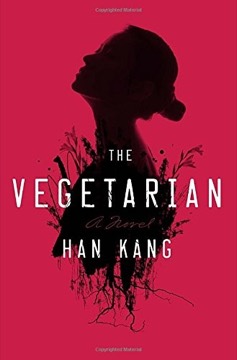
The Vegetarian
Han Kang's novel about a Korean woman who stops eating meat after a dream, and the three people around her who narrate her disappearance from ordinary life. Winner of the International Booker.
- First published
- 2007
- Publisher
- not established
- Pages
- 192
- Shelf
- Fiction
- Level
- Core
- ISBN-13
- 9789636767037
Record checked against
Catalogue note
- Reads as
- ReflectiveChanges how you see rather than what you do.
- Level
- Core / BuildingAssumes general familiarity with the subject.
- Approach
- Theoretical
- Written for
- Readers of literature, Readers with some grounding
Saved in this browser only — no account, nothing sent anywhere. My library
Read this if
- You read for the writing as much as for the argument.
- You want to be kept up late, and made uneasy about who to believe.
- You want a book that changes how you see things rather than what you do tomorrow.
- You know roughly how the subject works and want the fuller account.
The premise
Yeong-hye, described by her husband as completely unremarkable, has a dream and decides to stop eating meat. In a South Korean family context this is not a dietary preference but a refusal, and it is treated as one.
The novel is in three parts, narrated by her husband, her brother-in-law and her sister. Yeong-hye herself speaks only in brief italicised fragments.
The woman at the centre never narrates. Three people describe her, and none of them is trying to understand her.
Devmark’s reading — not a quotation from the book
The structure
Each narrator wants something from her — normality, artistic and sexual subject matter, explanation — and each account says more about the narrator than about Yeong-hye.
Han withholds interiority deliberately. The refusal to give the reader access is the novel's method: you are placed exactly where the family is, watching someone become unreachable.
Themes
The book is about bodily autonomy under a set of pressures — patriarchal, familial, social — that do not recognise it as a category. It is also about violence, including the ordinary kind that is not named as violence.
Han has said it grew from a line of Korean poetry about wanting to be a plant. The transformation Yeong-hye pursues is not a metaphor for illness alone, and the novel resists that reading.
It is not a book about an eating disorder, and it resists being read as one.
Devmark’s reading — not a quotation from the book
What to know
It contains sexual assault, self-harm and force-feeding, described directly, and is short and relentless rather than gradual.
Deborah Smith's translation won the Booker jointly with Han and has been substantially debated by Korean-English translators for how far it departs from the original. That argument is worth knowing about.
Three narrators, and she is not one
The novella is told by Yeong-hye's husband, her brother-in-law and her sister. She herself appears only in brief italicised dream fragments. The structural decision is the argument: a woman who stops eating meat becomes a problem to be interpreted by everyone around her, and never gets to account for herself.
Everybody in this book explains her. She is never once permitted to explain herself.
Devmark’s reading — not a quotation from the book
The husband's opening
The first section is narrated by a man who chose his wife specifically for being unremarkable, and who experiences her decision as an inconvenience to his career. His tone is reasonable throughout, which is what makes the section so disturbing — the reader is inside an ordinary man describing coercion as common sense.
The family dinner
The scene in which Yeong-hye's father attempts to force meat into her mouth in front of the assembled family is the book's hinge and one of the most shocking passages in recent fiction. It establishes that the violence in question predates her refusal and was always available.
The brother-in-law
The middle section moves to a video artist who becomes obsessed with the idea of painting flowers onto bodies and filming them, and it complicates the book considerably. His interest in Yeong-hye is unmistakably exploitative and self-serving, and it is simultaneously the only attention anyone pays her in the entire novel that treats her as something other than a malfunction to be corrected.
Wanting to be a tree
Yeong-hye's progression from refusing meat, to refusing food, to standing in sunlight and believing she is becoming a plant is never presented as a metaphor waiting to be decoded. Han holds it precisely between psychiatric delusion and genuine transformation, and the final section's setting in a hospital, narrated by her exhausted sister, does not settle the question in either direction.
Translation and the argument about it
The English version won the International Booker and was later the subject of detailed criticism from Korean-speaking scholars over departures from the original. Han has defended the translation and the debate continues; it is a useful reminder that a translated novel is a collaboration, and readers should know this one is contested.
What to take away
- 01Three narrators, none of them herHusband, brother-in-law and sister; she speaks only in fragments.
- 02Refusal, not dietVegetarianism read by everyone around her as an act against them.
- 03Withheld interiorityThe reader is placed exactly where the family is.
- 04Bodily autonomyPursued in a context with no category for it.
- 05A debated translationSmith's English version departs from the Korean in contested ways.