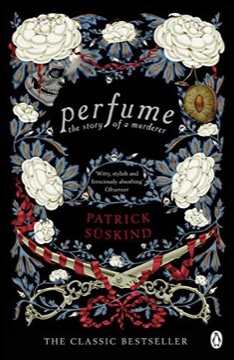
Perfume
Die Geschichte eines Mörders
Patrick Süskind's 1985 novel about a man born in eighteenth-century Paris with no personal odour and an extraordinary sense of smell, who becomes a murderer in pursuit of a perfect scent.
- First published
- 1985
- Publisher
- Tea
- Pages
- 263
- Shelf
- Thriller
- Level
- Core
- ISBN-13
- 9788467219791
Record checked against
Catalogue note
- Reads as
- ReflectiveChanges how you see rather than what you do.
- Level
- Core / BuildingAssumes general familiarity with the subject.
- Approach
- Theoretical
- Written for
- Readers who mean to stop at one more chapter, Readers with some grounding
Saved in this browser only — no account, nothing sent anywhere. My library
Read this if
- You read for the writing as much as for the argument.
- You want to be kept up late, and made uneasy about who to believe.
- You want a book that changes how you see things rather than what you do tomorrow.
- You know roughly how the subject works and want the fuller account.
The premise
Jean-Baptiste Grenouille is born under a fishmonger's stall in the filthiest part of 1738 Paris, survives an infancy nobody wants him to survive, and proves to have an olfactory sense of impossible acuity.
He has no scent of his own, which makes other people obscurely uneasy in his presence, and he becomes fixated on capturing and preserving the scents he values most.
He can smell everything and gives off nothing, and both facts organise his life.
Devmark’s reading — not a quotation from the book
Smell as the medium
The novel's achievement is sustained description of an experience prose is badly equipped for. Süskind builds an entire sensory vocabulary and uses it consistently for three hundred pages.
The eighteenth-century city is rendered almost entirely through odour — tanneries, corpses, markets, bodies — and the effect is genuinely immersive rather than merely clever.
Grenouille as a void
He has almost no interiority in the conventional sense: no morality, no attachment, no self-conception beyond appetite.
The novel treats this as a consequence of his scentlessness. Having no smell, he has no social existence, and the book suggests that identity is substantially a matter of how others register you.
Perfumery as craft
Long sections detail enfleurage, distillation, the economics of the Grasse trade and the composition of a formula, and the technical material is accurate and absorbing.
The craft passages function the way procedure does in a thriller: they make the impossible project seem feasible step by step.
Genre
It is a historical novel, a murder narrative, a fable and a satire, and it declines to settle into any of them.
The murders are treated almost without moral weight, described in the same register as a distillation, which is the book's most disturbing and most deliberate decision.
The Enlightenment setting
Süskind sets the story in the century of reason and fills it with superstition, filth and commercial cruelty, and several characters expound rationalist theories that are comprehensively wrong.
The satire is directed at the period's confidence in its own understanding, and Grenouille's genius is precisely the faculty that century least valued.
Power and manipulation
Once Grenouille can construct scents that produce emotional responses, he acquires a means of controlling how people feel about him without their knowledge.
The novel becomes an argument about charisma as a manufactured effect, and the late crowd sequence takes that to a conclusion that is both absurd and logically earned.
The prose
Ornate, ironic and mock-eighteenth-century, with an intrusive narrator who comments, digresses and passes judgement in the manner of a period chronicler.
The English translation by John E. Woods is widely admired and preserves the register, which is essential since the tone carries most of the book's effect.
The women
Grenouille's victims are young women valued entirely for their scent, and the novel describes them almost exclusively as raw material.
Whether this constitutes critique of objectification or an instance of it is the standing argument about the book. The narration's coldness is deliberate, but it is also relentless.
Its reception
It was an enormous international success and remains one of the best-known German novels of the late twentieth century.
Süskind withdrew almost entirely from public life afterwards, declining interviews, prizes and nearly all comment on the book, which has itself become part of the novel's mythology. He has published very little since, and the silence has been read as consistent with the work.
The film
Tom Tykwer's 2006 adaptation is visually inventive and necessarily loses the narration's irony, which is where much of the novel's meaning sits.
It also softens Grenouille toward pathos, giving him a longing the prose version does not grant. The book is considerably colder about him and offers the reader no route to sympathy at all, which is the harder and more interesting position.
Reading it now
It is shorter and faster than its reputation suggests, and the craft and period material make it absorbing even for readers uninterested in the fable.
Expect no moral instruction and no likeable character. It is a novel about appetite, rendered with complete technical seriousness and no warmth at all.
What to take away
- 01A sense prose cannot easily carryThe novel sustains three hundred pages of olfactory description by building a consistent vocabulary for it.
- 02Identity as something others registerGrenouille has no scent and therefore no social existence, which the book treats as the cause of his emptiness.
- 03Craft passages as procedureEnfleurage and distillation are detailed accurately, making an impossible project feel feasible step by step.
- 04Murder in a flat registerKillings are described in the same tone as a distillation, which is the book's most deliberate and most disturbing choice.
- 05Charisma manufacturedOnce scent can produce emotion, the novel becomes an argument about attraction as an engineered effect.
- 06Enlightenment satirisedSet in the century of reason and filled with filth and confident error, with rationalist characters who are comprehensively wrong.