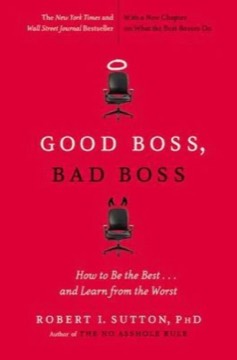
Good Boss, Bad Boss
Robert Sutton's research-grounded account of what distinguishes effective bosses from destructive ones — written by a Stanford organisational researcher, and unusual in this shelf for citing evidence rather than anecdote.
- First published
- 2010
- Publisher
- Business Plus
- Pages
- 192
- Shelf
- Leadership
- Level
- Core
- ISBN-13
- 9780446556088
Record checked against
Only one source carried a publication date for this work, so the year is uncorroborated.
Catalogue note
- Reads as
- PracticalWritten to be applied, not only understood.
- Level
- Core / BuildingAssumes general familiarity with the subject.
- Approach
- Practical
- Written for
- Managers, Readers with some grounding
- Ideas
Saved in this browser only — no account, nothing sent anywhere. My library
Read this if
- You are responsible for other people's work as well as your own.
- You want something to apply, not only something to think about.
- You know roughly how the subject works and want the fuller account.
The research posture
Sutton is an academic who writes for practitioners, and the book's distinguishing feature is that claims are attached to studies rather than to consulting experience.
He is also explicit about uncertainty, flagging where evidence is strong, where it is suggestive, and where he is offering an opinion — a discipline almost entirely absent from the rest of this shelf.
He marks which claims are evidenced and which are opinion, which almost nobody else in this shelf does.
Devmark’s reading — not a quotation from the book
Taking charge without illusions
His opening argument addresses a genuine tension: bosses must project enough confidence to give their teams direction, while knowing that their control and their judgement are considerably more limited than they appear.
His resolution — hold strong opinions weakly held, act decisively while actively hunting for evidence you are wrong — is the practical stance the book returns to repeatedly.
The performance-humanity pairing
His central framing: a good boss is responsible both for getting the work done and for the dignity and wellbeing of the people doing it, and treating these as a trade-off is the characteristic failure.
His evidence is that the two are correlated rather than opposed in most settings, which cuts against the belief that a demanding boss must be an unpleasant one.
What bosses do to people
His review of the research on the effects of a boss on health, stress and life satisfaction is the most sobering material in the book.
The finding that a bad boss produces measurable physiological harm, and that the effects persist outside working hours, reframes management from a performance question into something closer to a duty of care.
Being in tune
His treatment of self-awareness: bosses systematically misjudge how they are experienced, because their behaviour is magnified by the power differential and because subordinates filter what they report upward.
His practical instruments — soliciting anonymous feedback, watching for whether people bring bad news, and asking what you do that makes work harder — address the specific blind spot rather than self-awareness in general.
Your behaviour is magnified by the power difference, and the people best placed to tell you are the least likely to.
Devmark’s reading — not a quotation from the book
The no-asshole rule, applied
His earlier book's argument, developed here with more evidence: a persistently demeaning person imposes costs — turnover, withheld information, defensive behaviour, litigation — that almost always exceed their individual contribution.
His total cost of jerks accounting exercise is the useful contribution, because it converts a judgement about culture into a number a sceptical executive can engage with.
Shielding
His concept of the boss as a buffer: absorbing organisational noise, unreasonable demands and political pressure so the team can work.
His argument is that this is a large and largely invisible part of the job, and that a boss who passes everything downward is not being transparent but is failing to do the work of filtering.
Small gestures and their disproportion
His material on the outsized effect of minor behaviours — being interrupted, being kept waiting, having a suggestion ignored — because the power differential amplifies them.
The practical point is that improvement rarely requires a change of character, and usually requires noticing a handful of small repeated behaviours.
Where it is limited
The research he draws on is mostly correlational, and some of the social psychology cited comes from an era subsequently affected by the replication debates.
The book is also organised as a set of themes rather than a developed argument, which makes it useful as a reference and somewhat disjointed as a read.
What to take from it
The shielding idea, which names an important and unrecognised part of the job and is a good self-check: how much of what reaches me am I passing straight through?
And the evidence about physiological harm, which is the most compelling available argument for taking the quality of management seriously as something other than a productivity question.
What to take away
- 01Performance and humanity are correlatedTreating them as a trade-off is the characteristic failure, and the evidence does not support the trade-off.
- 02A bad boss causes measurable harmThe effects are physiological and persist outside working hours, which changes what kind of question this is.
- 03Power magnifies small behavioursAn interruption or an ignored suggestion lands far harder than the person doing it can feel.
- 04Shielding is most of the jobA boss who passes everything downward is not being transparent; they are failing to filter.
- 05Price the difficult high performerTurnover, withheld information and defensive behaviour are countable, and almost always exceed the contribution.