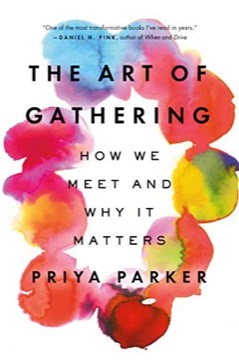
The Art of Gathering
Priya Parker's argument that most meetings, dinners, conferences and ceremonies fail because nobody decided what they were for, and that hosting is a set of decisions rather than a hospitality style.
- First published
- 2018
- Publisher
- Penguin Publishing Group
- Pages
- 320
- Shelf
- Communication
- Level
- Entry
- ISBN-13
- 9780241973844
Record checked against
Catalogue note
- Reads as
- PracticalWritten to be applied, not only understood.
- Level
- Accessible / FoundationalNo prior reading assumed.
- Approach
- Practical
- Written for
- Writers and speakers, Newcomers to the subject
- Ideas
Saved in this browser only — no account, nothing sent anywhere. My library
Read this if
- You are responsible for other people's work as well as your own.
- You want something to apply, not only something to think about.
- You are starting from scratch here and want a way in that assumes no prior reading.
The argument
Parker, a conflict facilitator who has worked on dialogue processes in post-conflict settings, argues that gatherings default to category — this is a board meeting, this is a birthday — and that the category then supplies a format nobody examined.
Her replacement is purpose: a specific, disputable, singular reason this group is in this room, from which every other decision follows.
A purpose that nobody could disagree with is not a purpose. It is a category.
Devmark’s reading — not a quotation from the book
Generous authority
Her most contested idea is that hosts should exercise authority rather than minimise it: decide who is in the room and who is not, protect guests from each other, and enforce the structure.
She argues that abdicating this in the name of informality does not remove power from the gathering; it hands it to whoever is most confident, which is usually worse.
Refusing to host does not remove authority from a room. It transfers it to the loudest person there.
Devmark’s reading — not a quotation from the book
The practical content
Exclusion as a service to the group. The importance of the period before the event and the moments immediately after arrival, which she argues do most of the work. Opening without logistics. Ending deliberately rather than letting a gathering dissolve.
The chapter on rules versus etiquette — temporary explicit rules beating assumed unspoken norms — is the most immediately usable.
Who it is for
Anyone who runs meetings, teaches, organises events, or hosts anything with more than a few people. The examples run from boardrooms to funerals.
It is a book of decisions rather than techniques, and the decisions are harder than the techniques would be.
It is also short and entirely free of the case-study padding that usually inflates this category, which means the ratio of usable ideas to pages is unusually high.
Purpose, not category
Parker's opening move is that most gatherings are organised around a format — a team meeting, a birthday, a conference — and that the format then supplies the content by default. Her demand is a specific, disputable purpose that could have been otherwise, on the grounds that a purpose you cannot fail to meet is not a purpose.
A birthday is a category. It is not a reason, and it will not tell you what to do with the evening.
Devmark’s reading — not a quotation from the book
Exclusion is a service
Her most uncomfortable argument is that generous inclusion usually damages the gathering: every additional person changes what can be said, and a host who cannot exclude cannot protect the purpose. She frames the difficult conversation about who is not invited as work owed to the people who are.
Most of it happens beforehand
Her claim is that a gathering is largely determined before anyone arrives — by the invitation's wording, by what people were told to expect, by who was asked and how, and by the state they are in when they walk through the door. The implication is that the effort most hosts put into the event itself is arriving far too late to change much.
A temporary world
She advocates explicit, arbitrary, time-limited rules in place of unstated etiquette, and the reasoning is about access rather than novelty: a rule can be announced to everyone in the room at the same moment, while etiquette is known only to the people who were raised inside it. A stated rule therefore levels a mixed group in a way that good manners, by their nature, structurally cannot.
The opening
Her strongest practical chapter concerns the first minutes, which she argues are almost always spent on logistics, housekeeping and thanks — the least interesting material, delivered when attention is highest. The alternative is to open with something that states what this is, and to move the administration elsewhere.
Good controversy
She makes a case for deliberately surfacing the disagreement a group is avoiding, with structure and with a facilitator, on the grounds that the unspoken conflict is already shaping the room and is doing so unmanageably. This is where her background in conflict resolution is most visible.
Endings
Gatherings, in her account, are routinely allowed to dissolve rather than close, which wastes the last opportunity to say what happened. She recommends a deliberate ending with two parts — looking inward at the group, then turning outward to what people are returning to — and treats the logistical goodbye as a separate thing entirely.
What to take away
- 01Purpose over categoryA specific disputable reason, not a label.
- 02Generous authorityHosting as a set of decisions, actively exercised.
- 03Exclusion serves the groupWho is not in the room is part of the design.
- 04Rules beat etiquetteTemporary explicit rules outperform assumed norms.
- 05Beginnings and endingsMost of the work happens at the edges, not the middle.