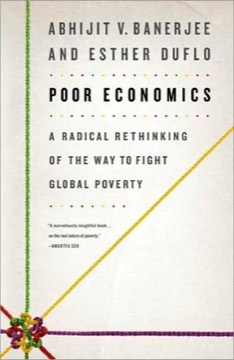
Poor Economics
A radical rethinking of the way to fight global poverty
Abhijit Banerjee and Esther Duflo's account of what randomised controlled trials reveal about poverty, and why the big ideological argument about aid asks the wrong question.
- First published
- 2011
- Publisher
- Publicaffairs
- Pages
- 320
- Shelf
- Money
- Level
- Core
- ISBN-13
- 9781610390934
Record checked against
Catalogue note
- Reads as
- ConceptualExplains how something works before what to do about it.
- Level
- Core / BuildingAssumes general familiarity with the subject.
- Approach
- Theoretical
- Written for
- Investors and savers, Readers with some grounding
- Ideas
Saved in this browser only — no account, nothing sent anywhere. My library
Read this if
- You want to see the incentives underneath the headlines.
- You want to understand how it works before deciding what to do about it.
- You know roughly how the subject works and want the fuller account.
The approach
Banerjee and Duflo, who later shared the Nobel with Michael Kremer, argue that the debate between aid optimists and aid sceptics is unresolvable at the level it is conducted, and that specific questions are answerable.
Their method is field experiment: randomise an intervention across comparable villages or schools and measure what changes. The book reports what those trials found, including where they contradicted the authors' expectations.
The argument about whether aid works is unanswerable. Whether this bednet programme works is not.
Devmark’s reading — not a quotation from the book
The findings
Why people with very little money buy television sets rather than more food. Why free bednets are used and cheap ones are not. Why immunisation rates respond to a bag of lentils. Why microcredit's effects are real but far smaller than claimed. Why children stay in school when a specific cost is removed.
The recurring theme is that the poor face the same cognitive and motivational constraints as everyone else, with far less margin for error and far more decisions to make.
The poor make the same mistakes as everyone else, with no buffer and vastly more decisions to make.
Devmark’s reading — not a quotation from the book
What to know
RCT methodology has been criticised for external validity — a result in Rajasthan may not transfer to Kenya — and for concentrating on interventions small enough to randomise while structural questions go unexamined.
Duflo and Banerjee address this partially. The book is best read as demonstrating what careful measurement can settle, and as honest about the size of what it leaves open.
Ideology, ignorance, inertia
Their diagnosis of why programmes fail names three causes that have nothing to do with the poor: policy set by conviction rather than evidence, decisions made without knowing basic facts about the intended recipients, and systems that continue because stopping them is harder than not. Each is addressable, which is the book's reason for optimism.
The calorie surprise
One of the most cited findings is that when very poor households get more money they frequently do not buy more calories: they buy better-tasting food, or a television. The authors decline both the moralising and the romantic readings, and take it as evidence that the nutritional poverty trap is weaker than assumed and that people are making trade-offs that include not being bored.
Free beats cheap
The work on insecticide-treated bednets produced a result that surprised almost everyone: charging even a small amount sharply reduced uptake, while giving them away did not lead recipients to value or use them less. It undermined a long-standing development orthodoxy about cost-sharing and is one of the clearest cases of a trial overturning a confident prior.
A small price did not select for people who would use it. It just meant far fewer had one.
Devmark’s reading — not a quotation from the book
Lentils and immunisation
Immunisation completion rates in one Indian trial rose dramatically when clinics offered a small bag of lentils per visit. The interpretation matters: the obstacle was not belief or information but the small recurring friction of travelling for a benefit that is invisible and deferred, and a trivial immediate reward was enough to overcome it.
Microcredit, deflated
The randomised evidence on microfinance found real but modest effects: some increase in business investment, little evidence of transformed incomes, health, education or women's empowerment at the scale claimed. The authors are careful — it is a useful financial product, not a mechanism for ending poverty — and the chapter is a model of reporting a disappointing result without discarding it.
The objection from economics
The approach has serious critics within the discipline, most prominently on external validity: a result established in one district may not transfer, the method answers narrow questions well and large structural ones badly, and the emphasis risks displacing work on growth, trade and institutions that randomisation cannot reach. The authors acknowledge the limit and do not fully answer it.
What to take from it
The transferable habit is the authors' own: take the large unanswerable question, replace it with the small answerable one, and expect the answer to be counter-intuitive often enough to justify the trouble of asking rather than assuming. The individual findings in this book will date as the trials are repeated and extended in other places; the discipline that produced them will not, and that is the part worth carrying away.
What to take away
- 01Answerable questionsReplace the aid debate with specific measurable ones.
- 02Free beats cheapPricing bednets at zero raises usage, contrary to the incentive argument.
- 03Lentils and immunisationA small reliable incentive shifts behaviour more than persuasion.
- 04Microcredit, deflatedReal effects, much smaller than the movement claimed.
- 05External validityThe main methodological objection: results may not travel.