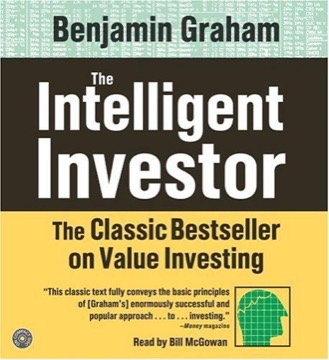
The Intelligent Investor
Benjamin Graham's 1949 book on investing as a discipline of temperament rather than forecasting, built on the separation of price from value and on an insistence that the investor's first job is to avoid serious loss.
- First published
- 1949
- Publisher
- Harper & Brothers
- Pages
- 352
- Shelf
- Money
- Level
- Deep
- ISBN-13
- 9780060555665
Record checked against
Catalogue note
- Reads as
- StrategicAbout choosing between options under uncertainty.
- Level
- Advanced / AdvancedAssumes you have read around the subject already.
- Approach
- Applied
- Written for
- Investors and savers, Specialists and serious readers
- Ideas
Saved in this browser only — no account, nothing sent anywhere. My library
Read this if
- You want to think clearly about risk before you think about returns.
- You are weighing options and want a way to think about the trade-offs.
- You have read around this already and want a book that assumes it.
The core idea
Graham's definition sets the frame: an investment operation is one which, on thorough analysis, promises safety of principal and an adequate return. Anything failing that test is speculation — not forbidden, but it should be named.
The book's project is to make investing a set of rules that protect an ordinary person from their own judgement, rather than an attempt to out-predict the market.
Graham's question is not what will go up. It is what cannot easily go badly wrong.
Devmark’s reading — not a quotation from the book
The defensive and the enterprising investor
Graham divides readers in two and refuses a middle. The defensive investor wants freedom from effort and worry: a fixed allocation between high-grade bonds and diversified stocks, never less than 25% or more than 75% in either, rebalanced mechanically.
The enterprising investor is willing to devote serious, continuous work to security analysis. Graham's warning is that most people who believe themselves enterprising are in fact defensive investors doing extra trading, and that this combination produces the worst results available.
Mr Market
The book's most durable invention is a parable. Imagine a business partner who appears daily quoting a price at which he will buy your share or sell you his — and whose quotes swing between euphoria and despair for reasons that have nothing to do with the business.
The point is that he is there to serve you, not to instruct you. You are never obliged to transact, and the fact that a low price is being offered is information about him rather than about what you own.
Margin of safety
Graham calls this the central concept of investment, and it is a single idea: buy at a sufficient discount to conservatively estimated value that even a substantially wrong estimate does not produce a permanent loss.
Its purpose is to absorb error rather than to maximise return. This is the most transferable idea in the book, and it is really an argument about epistemic humility expressed in prices.
The margin exists because your analysis will be wrong. It is priced-in humility, not a profit target.
Devmark’s reading — not a quotation from the book
Price and value
Running through everything is the insistence that a share is a fractional ownership of a business, not a ticker with momentum. Value comes from earnings, assets and the durability of the enterprise; price comes from whatever people happen to feel.
Graham's argument is that the two converge over long periods and diverge violently over short ones — and that the entire opportunity available to a disciplined investor lives in that divergence.
What Graham says about forecasting
He is consistently, almost bracingly, sceptical of prediction. He dismisses market timing, treats most forecasting as entertainment, and is scathing about the idea that the average investor can identify in advance which industries will do well.
His alternative is not a better forecast but a structure that does not require one: diversification, quality criteria, a fixed rebalancing policy, and a price low enough to survive being wrong.
The defensive investor's actual rules
Graham gives specific criteria — adequate size, sufficiently strong financial condition, a record of continuous dividends, earnings stability, growth over a decade, and moderate price-to-earnings and price-to-book ratios.
The numeric thresholds are the most dated part of the book, written for a different market with different accounting. The structure of the test — a short list of quality and price hurdles applied mechanically — has aged far better than any of its specific numbers.
Zweig's commentary
Most readers encounter the revised edition with Jason Zweig's chapter-by- chapter commentary, and it materially changes the book. Zweig supplies the modern examples Graham could not, covers index funds, and translates criteria written before the transformation of the market.
It is worth reading the Graham chapter first and the commentary second, rather than interleaved. Graham's argument has a shape, and the commentary is easier to weigh once you have the shape.
Where it is hard going
The prose is of its period: formal, dense, and heavy with worked examples from companies that no longer exist. Substantial sections on bond analysis and securities regulation are of historical interest only.
It is also genuinely long, and the most valuable material is concentrated — the investor/speculator distinction, Mr Market, and margin of safety carry most of the enduring argument.
What survives
The temperamental argument, entirely. Graham's claim is that the investor's chief problem, and even worst enemy, is likely to be themselves — and every subsequent decade has supported it.
Its practical descendants are everywhere: index investing, mechanical rebalancing, and the general advice to automate decisions so they are not made under emotional pressure all descend from a framework Graham set out before any of them existed.
What to take away
- 01Name the operation honestlyIf it does not promise safety of principal on thorough analysis, it is speculation — which is allowed, but should be called that.
- 02Mr Market serves youA quoted price is information about the market's mood, not an instruction about your holding.
- 03The margin absorbs your errorIt exists because your valuation is wrong, not because you expect the discount to close.
- 04Build a structure that needs no forecastDiversification, quality hurdles and fixed rebalancing replace prediction rather than improving it.
- 05You are the main riskGraham's conclusion after a career: the investor's worst enemy is most likely themselves.