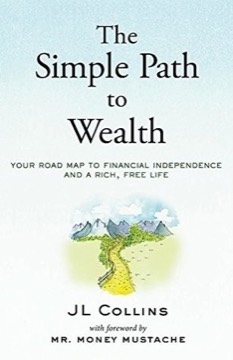
The Simple Path to Wealth
J. L. Collins's case for a deliberately boring investing strategy — broad low-cost index funds, held through everything — originally written as letters to his daughter.
- First published
- 2016
- Publisher
- Authors Equity
- Pages
- 289
- Shelf
- Money
- Level
- Entry
- ISBN-13
- 9781543697971
Record checked against
Sources disagree on the publication year (openlibrary 2000, wikidata 2016). The value shown is the one preferred by the most reliable source for original publication date; the disagreement is recorded rather than resolved.
Catalogue note
- Reads as
- PracticalWritten to be applied, not only understood.
- Level
- Accessible / FoundationalNo prior reading assumed.
- Approach
- Practical
- Written for
- Investors and savers, Newcomers to the subject
- Ideas
Saved in this browser only — no account, nothing sent anywhere. My library
Read this if
- You want to think clearly about risk before you think about returns.
- You want something to apply, not only something to think about.
- You are starting from scratch here and want a way in that assumes no prior reading.
The argument
Collins's position is that the market rewards persistence rather than skill, that costs and taxes are the two variables an investor actually controls, and that complexity is mostly a mechanism for transferring money from investors to intermediaries.
His concrete recommendation is a total stock market index fund during the wealth-building years, with bonds added later for smoothing, and nothing else.
The whole strategy fits in a sentence, which is the point rather than a limitation.
Devmark’s reading — not a quotation from the book
F-you money
The book's organising idea is that the purpose of saving is optionality, not retirement: enough capital to refuse things. Collins frames every decision around buying the ability to walk away.
He is also clear-eyed about the corollary — that this requires a savings rate most people find uncomfortable, and that the rate matters more than the returns for the first decade.
The savings rate matters more than the returns until the portfolio is large enough to do the work.
Devmark’s reading — not a quotation from the book
The caveats
Collins is candid that he is not a professional and that the approach depends on behaviour: the strategy only works if you do not sell during a crash, and most of the book is about that rather than about selection.
It is US-centric in its fund examples and tax treatment. The principle — broad, cheap, held — transfers; the tickers do not.
The two stages
Collins divides an investing life into wealth accumulation and wealth preservation, and argues the allocation should differ between them rather than drifting. In accumulation the recommendation is a single broad total-market equity index fund and nothing else; in preservation, bonds enter to smooth the ride. The simplicity is deliberate — he treats every additional holding as another decision you can get wrong later.
Why he distrusts advisers
A substantial portion of the book is an argument that the financial industry is structured to extract fees from complexity it also supplies. His case rests on arithmetic rather than accusation: a percentage taken annually compounds against you exactly as returns compound for you, and over decades the difference is a large fraction of the final figure. He extends the same suspicion to actively managed funds.
A fee compounds against you on precisely the same curve your returns compound for you.
Devmark’s reading — not a quotation from the book
The crash question
Collins meets the obvious objection directly. His answer is that the market's declines are real, recurrent and survivable, and that the damage in every case he examines was done by selling rather than by falling. He is honest that this is a claim about investor behaviour more than about markets, and that the strategy has no defence against someone who abandons it at the bottom.
Withdrawal and the 4% rule
The later chapters cover spending the money down, using the Trinity study's widely cited withdrawal figure. Collins presents it as a planning heuristic rather than a guarantee, notes it was derived from a specific historical period and portfolio, and points out that most real retirees adjust spending rather than mechanically withdrawing through a downturn.
Where it is narrow
The book is written for a United States investor and the specifics do not travel: the fund names, the tax-advantaged account structure and the tax treatment are all American. Its historical evidence is drawn overwhelmingly from the twentieth-century US market, which is the strongest sustained equity record in the world and may not be the right base rate for anywhere else.
Where it is contested
The 100% equity allocation during accumulation is more aggressive than most advisers would recommend, and its defence depends on the investor genuinely not flinching. Collins is also notably cool on home ownership as an investment, which is a defensible position but is presented more confidently than the evidence supports.
What to take from it
Read it for the argument that costs and behaviour are the two variables you control, and for the clarity of a plan simple enough to hold through a downturn. Treat the specific fund names, account types and tax advice as local detail to be re-derived wherever you actually live.
What to take away
- 01Costs are the controllableFees and taxes are what an investor actually decides.
- 02One fund is enoughA total market index fund during accumulation, bonds later.
- 03F-you moneyThe goal is the ability to refuse, not a retirement date.
- 04Behaviour is the riskThe strategy fails only if you sell during a decline.
- 05Written as lettersIt began as advice to his daughter, which shapes the plainness.