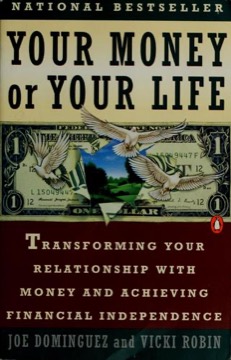
Your Money or Your Life
Vicki Robin and Joe Dominguez's programme for changing the relationship between money and time, built on the idea that money is something you trade your life energy for — and that most spending decisions look different once measured in hours rather than currency.
- First published
- 1992
- Publisher
- Robin, Vicki
- Pages
- 376
- Shelf
- Money
- Level
- Entry
- ISBN-13
- 9780140267648
Record checked against
Catalogue note
- Reads as
- PracticalWritten to be applied, not only understood.
- Level
- Accessible / FoundationalNo prior reading assumed.
- Approach
- Practical
- Written for
- Investors and savers, Newcomers to the subject
Saved in this browser only — no account, nothing sent anywhere. My library
Read this if
- You want to think clearly about risk before you think about returns.
- You want to understand what makes people willing to follow a decision.
- You want something to apply, not only something to think about.
- You are starting from scratch here and want a way in that assumes no prior reading.
Life energy
The book's foundational reframe: money is not wealth, it is what you exchange your finite hours for. A purchase therefore costs a quantity of life, and the price tag conceals this.
Everything in the programme descends from converting currency into hours and evaluating expenditure in those terms — which reliably makes some routine spending look absurd and some expensive things look reasonable.
The price is not the number on the tag. It is the hours of your life the number represents.
Devmark’s reading — not a quotation from the book
Your real hourly wage
Step one of the programme, and the mechanism that makes the reframe concrete. Take income and subtract every cost of earning it — commuting, clothing, meals out from exhaustion, decompression spending, the higher housing cost of living near the job — and divide by every hour it actually consumes, including the ones spent recovering.
The resulting figure is usually substantially lower than the nominal wage, and the gap is the book's most persuasive single argument.
Tracking every transaction
The programme requires recording every unit of money that enters or leaves your life, with no exceptions and, importantly, no shame attached.
The authors are explicit that this is not budgeting. There is no plan being adhered to; the purpose is accurate data about what is actually happening, because almost nobody knows.
The three questions
The evaluative core, applied monthly to each spending category. Did I receive fulfilment, satisfaction and value in proportion to the life energy spent? Is this expenditure aligned with my values and purpose? How might this change if I did not have to work for money?
The third question does most of the work, because it separates spending that serves the life from spending that services the job.
The crossover point
Their central financial concept: chart monthly expenses against monthly income from investments, and the point where the second line crosses the first is financial independence.
This is the passage that seeded the modern financial-independence movement, and its influence considerably exceeds the book's own readership — much of that movement's vocabulary descends from here.
Two lines on a chart: expenses and investment income. Where they cross is the point work becomes optional.
Devmark’s reading — not a quotation from the book
Frugality reframed
Their argument that frugality is about enjoying what you have fully rather than about deprivation, and that the enemy is not spending but unconscious spending.
The related concept is enough — a point of maximum fulfilment beyond which additional purchases reduce satisfaction through clutter, maintenance and obligation. The curve, rather than the moralising, is what makes this persuasive.
Where it has dated
The original investment advice — long-term US Treasury bonds as the vehicle for independence — reflected an interest-rate environment that no longer exists, and has been substantially revised in later editions.
Revised versions address index funds and modern accounts, but a reader should treat the specific financial instruments as the most perishable part of the book and the behavioural programme as the durable part.
Where it is limited
The programme assumes discretion over spending and a wage that exceeds subsistence. For someone whose income does not cover necessities, tracking and evaluation reveal a problem they already know about and cannot solve by reframing.
The authors acknowledge this only lightly, and the book's framing — choosing to spend less — presumes choices not everyone has.
Why it endures
Because the central conversion is genuinely transformative and costs nothing to try. Working out a real hourly wage and pricing a few routine purchases in hours changes behaviour more reliably than any budgeting system.
Its cultural influence is also disproportionate: the financial independence movement, the idea of enough, and much of the vocabulary around time-money trade-offs trace back here.
What to take from it
Calculate the real hourly wage honestly, including recovery time and every cost of employment. Then price three recurring expenses in hours.
That exercise is the whole book in an afternoon, and most people who do it change something — which is a better hit rate than the programme's more elaborate later steps.
What to take away
- 01Price things in hoursConverting currency into life energy makes some routine spending look absurd and some expensive things reasonable.
- 02Compute the real wageSubtract every cost of earning and include recovery time; the gap from the nominal figure is the argument.
- 03Track without judgementThis is not budgeting against a plan. It is getting accurate data, which almost nobody has.
- 04Enough is a curve, not a ceilingBeyond a point, additional purchases reduce satisfaction through clutter, maintenance and obligation.
- 05The instruments have dated, the method has notTreat the specific investment advice as perishable and the behavioural programme as the durable part.