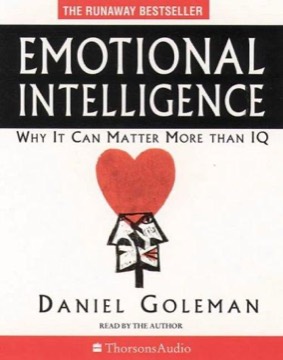
Emotional Intelligence
Daniel Goleman's 1995 synthesis popularising the argument that abilities in recognising and regulating emotion predict life outcomes substantially — and that these abilities are learnable rather than fixed.
- First published
- 1995
- Publisher
- Bantam Books
- Pages
- 368
- Shelf
- Mind
- Level
- Core
- ISBN-13
- 9780553375060
Record checked against
Catalogue note
- Reads as
- ConceptualExplains how something works before what to do about it.
- Level
- Core / BuildingAssumes general familiarity with the subject.
- Approach
- Theoretical
- Written for
- Curious general readers, Readers with some grounding
- Ideas
Saved in this browser only — no account, nothing sent anywhere. My library
Read this if
- You want evidence about why people behave as they do, not folklore.
- You want to understand how it works before deciding what to do about it.
- You know roughly how the subject works and want the fuller account.
The claim and its origins
Goleman is a science journalist synthesising the work of others, principally Peter Salovey and John Mayer, who had proposed emotional intelligence as a construct several years earlier.
His contribution was popularisation and the strong claim attached to it: that these abilities matter more than conventional intelligence for many outcomes, which is where most of the subsequent argument has concentrated.
The construct is Salovey and Mayer's. The claim that it outweighs IQ is Goleman's, and it is the contested part.
Devmark’s reading — not a quotation from the book
The five domains
His framework: self-awareness, self-regulation, motivation, empathy and social skill.
The first two are the foundation in his account — the ability to notice an emotional state as it arises and to modulate the response rather than being carried by it. The remaining three are treated as building on that base.
The amygdala hijack
His most durable contribution to popular vocabulary. Drawing on Joseph LeDoux's research, he describes a fast subcortical pathway that can trigger an emotional response before the cortex has fully processed the situation.
The underlying neuroscience is real, though Goleman's popularisation simplifies it considerably and the strict two-pathway picture has been refined substantially since.
Emotional hijacking and its management
The practical content follows: if the response arrives before the appraisal, regulation must operate on what happens next rather than on the initial reaction.
His recommendations — naming the emotion, creating a delay, reappraising the situation — anticipate techniques that later research has supported reasonably well, particularly affect labelling and cognitive reappraisal.
The marshmallow material
He gives prominent treatment to Walter Mischel's delay-of-gratification studies and their reported association with later outcomes.
This requires an update. Large replication work found the original association substantially weaker once family background and socioeconomic factors were controlled, and the popular version of the finding considerably overstates what the evidence supports.
The delay-of-gratification association largely attenuates once family background is controlled. The popular version overstates it.
Devmark’s reading — not a quotation from the book
Emotional intelligence at work
The organisational chapters made the book's commercial reputation, arguing that these competencies distinguish outstanding performers particularly in senior roles, and that the higher one goes in an organisation the more they matter relative to technical ability.
Much of the supporting evidence for this comes from consulting research and internal corporate competency studies rather than from peer-reviewed work, and the reported effect sizes have not held up well under independent scrutiny. This is the section of the book a reader should treat most sceptically, and it is the section most often cited in workplaces.
Education and prevention
His sections on social and emotional learning programmes in schools are the most constructive part of the book, and this is the area where the evidence has developed most positively.
Meta-analyses of well-implemented programmes have found modest but real improvements in behaviour and academic outcomes, which is a better record than most of the book's other claims.
Where the science disputes him
The central criticism is definitional: emotional intelligence as Goleman uses it is a broad mixture of traits, skills and motivations rather than a coherent construct, and much of it overlaps with established personality dimensions.
The ability-based model that Salovey and Mayer developed is measurable and more modest in its claims; Goleman's mixed model predicts less than it appears to once conscientiousness and agreeableness are accounted for. The specific claim that it outweighs IQ is not supported.
Why it mattered anyway
Its cultural effect exceeded its scientific standing. It made emotional competence a legitimate subject in workplaces and schools that had treated it as outside their concern, and it created demand for the social-emotional learning programmes whose evidence base is now reasonably good.
That is a real contribution even where the underlying claims were overstated.
How to read it now
As an influential popularisation with a strong claim that did not survive scrutiny and a set of practices that mostly did.
Take the self-regulation techniques, the affect-labelling insight and the educational material. Discard the comparative claim against IQ, treat the workplace research sceptically, and update the marshmallow chapter entirely.
What to take away
- 01Regulation acts after the reactionThe response frequently arrives before the appraisal, so the work is on what happens next.
- 02Naming the feeling helpsAffect labelling is one of the book's practices that later research supported reasonably well.
- 03The construct is a mixtureGoleman's model blends traits, skills and motives, and overlaps heavily with established personality dimensions.
- 04Update the marshmallow chapterThe association largely attenuates once family background is controlled.
- 05The cultural effect outran the evidenceIt legitimised a subject in schools and workplaces, and the programmes that followed have better support than the book.