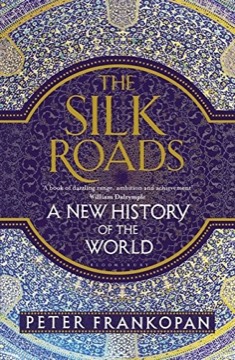
The Silk Roads
Peter Frankopan's history of the world with its centre moved — an argument that the region between the eastern Mediterranean and the Himalayas has been the pivot of global exchange for two millennia, and that European-centred history misreads the map.
- First published
- 2015
- Publisher
- Bloomsbury
- Pages
- 128
- Shelf
- History
- Level
- Deep
- ISBN-13
- 9781408889930
Record checked against
Catalogue note
- Reads as
- ReflectiveChanges how you see rather than what you do.
- Level
- Advanced / AdvancedAssumes you have read around the subject already.
- Approach
- Theoretical
- Written for
- Readers of history, Specialists and serious readers
Saved in this browser only — no account, nothing sent anywhere. My library
Read this if
- You want to know how we got here.
- You want to see the incentives underneath the headlines.
- You want a book that changes how you see things rather than what you do tomorrow.
- You have read around this already and want a book that assumes it.
The argument
Frankopan's thesis is that the standard account of world history — rising in Greece, passing through Rome, resting in western Europe and crossing to America — is a recent and parochial construction.
His alternative centre is the belt of territory from the eastern Mediterranean through Persia and Central Asia to China, which he argues has been where goods, religions, diseases, technologies and ideas actually moved for most of recorded history.
He is moving the map's centre, not adding a chapter. The claim is that the usual account is parochial.
Devmark’s reading — not a quotation from the book
Not one road
His clarification of the term: the silk roads were never a single route and were never primarily about silk. They were a shifting network of exchange across a wide region.
His chapter titles name the different things that travelled — faith, furs, slaves, silver, disease, revolution — and the structure makes the argument that the same corridors carried very different cargoes across different centuries.
Religions in motion
His early chapters on the movement of Buddhism, Christianity, Zoroastrianism, Manichaeism and Islam along the same routes as goods.
His treatment of the commercial context of religious spread — that missionaries travelled with merchants and that conversion frequently followed trade relationships — is one of his more persuasive threads.
The Islamic and Mongol centuries
His account of the period when the region was the world's economic and intellectual centre: the translation movement, the mathematics, the astronomy and the scale of urban life.
His treatment of the Mongol empire is revisionist in the now-standard direction, emphasising the trade security and exchange it enabled alongside the destruction, and he is careful about not overcorrecting.
The Black Death and the corridors
His account of plague moving along the same routes as commerce, and of its demographic and economic consequences across the whole belt rather than in Europe alone.
The chapter illustrates his method well: a phenomenon usually told as European history is retold as a network event with its origin and much of its impact elsewhere.
Why Europe went west
His reframing of the age of exploration: European powers sought sea routes because they were peripheral to the existing trade system and could not control its overland corridors.
The argument inverts the usual triumphalist account. Atlantic expansion becomes a workaround by players who were outside the main game rather than an expression of superiority, and the silver that flowed from the Americas was valuable largely because it could buy access to Asian markets.
Atlantic expansion as a workaround by peripheral players rather than a demonstration of superiority.
Devmark’s reading — not a quotation from the book
Oil and the twentieth century
His later chapters on the modern period: the British and Russian rivalry in Central Asia, the carve-up of the Middle East, the oil concessions, and the interventions that followed.
His account of the Anglo-Persian arrangements and of the 1953 coup is integrated into the longer argument — that outside powers have consistently sought control of the same corridors for changing reasons.
The forward-looking claim
His conclusion that the region is returning to centrality through energy, new infrastructure investment and shifting economic weight.
This is the book's most speculative section and the one most subject to events. He has written a follow-up volume, and a reader should treat the predictions with more caution than the history.
Where it is criticised
Reviewers have noted that the breadth comes at the cost of depth, that the specialist literature is compressed heavily, and that the book is stronger as a reframing than as a work of original research.
There is also a fair charge of elasticity: the silk roads expand to accommodate whatever the chapter needs, which weakens the thesis by making it difficult to falsify.
What it is good for
As a corrective to a mental map. Most readers educated in the Western tradition carry an implicit geography of history, and this book replaces it with a different one.
The correction survives the book's weaknesses, and a reader who finishes it reads subsequent history differently, which is the most a book of this scope can reasonably achieve.
What to take away
- 01Move the centre, not add a chapterThe claim is that the standard geography of world history is recent and parochial.
- 02Never one road, never mainly silkA shifting network that carried faith, disease, slaves and silver across different centuries.
- 03Europe sailed because it was peripheralAtlantic expansion was a workaround by players outside the main trading system.
- 04Plague was a network eventUsually told as European history, it moved along commercial corridors and struck the whole belt.
- 05The thesis is elasticThe silk roads expand to fit each chapter, which makes the argument hard to test.