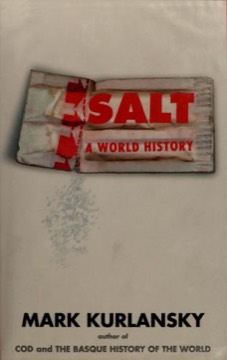
Salt: A World History
Mark Kurlansky's history of the world through a single mineral — the only rock humans eat, once valuable enough to found cities, fund armies and provoke rebellion, and now almost worthless.
- First published
- 2002
- Publisher
- New Millennium Press
- Pages
- 496
- Shelf
- History
- Level
- Entry
- ISBN-13
- 9780802713735
Record checked against
Only one source carried a publication date for this work, so the year is uncorroborated.
Catalogue note
- Reads as
- ReflectiveChanges how you see rather than what you do.
- Level
- Accessible / FoundationalNo prior reading assumed.
- Approach
- Theoretical
- Written for
- Readers of history, Newcomers to the subject
- Ideas
Saved in this browser only — no account, nothing sent anywhere. My library
Read this if
- You want to see the incentives underneath the headlines.
- You want a book that changes how you see things rather than what you do tomorrow.
- You are starting from scratch here and want a way in that assumes no prior reading.
The premise
Kurlansky's argument is that salt was a strategic commodity for most of human history: essential for life, essential for preserving food before refrigeration, unevenly distributed, and therefore a reliable source of wealth and conflict.
His method is to follow it across cultures and centuries rather than to narrate one region, which makes the book a sequence of connected episodes rather than a continuous history.
Essential, unevenly distributed and unstoreable food without it — which is why it was strategic for millennia.
Devmark’s reading — not a quotation from the book
Why it mattered so much
His explanation of the biology and the technology: humans require sodium, most inland diets do not supply enough, and until refrigeration salt was the primary method of preserving meat and fish.
The second point is the more consequential. A society's ability to store food through winter, to provision armies and to trade protein over distance all depended on salt supply.
Ancient production
His chapters on Chinese salt wells, including deep drilling technology developed centuries before anything comparable in Europe, and on Roman saltworks and the roads built to move the product.
His treatment of Chinese salt administration — a state monopoly maintained for two millennia and a substantial share of imperial revenue — is the book's clearest demonstration that salt policy was fiscal policy.
Preservation and cuisine
His chapters on what salt made possible: cured hams, salt cod, fermented sauces, cheese, pickling traditions.
His argument that the salt cod trade shaped North Atlantic settlement, that fish preservation drove exploration of fishing grounds, and that several national cuisines are essentially preservation techniques that outlived their necessity, is the most enjoyable material in the book.
The tax
His recurring political theme: salt's necessity made it the ideal thing to tax, and salt taxes have repeatedly provoked resistance.
The French gabelle, the Chinese monopoly and the British salt tax in India are his main cases. The pattern is consistent — a tax on something nobody can do without is a tax that cannot be avoided, which is why governments imposed it and why it generated such anger.
The Salt March
His treatment of Gandhi's 1930 march to the sea to make salt in defiance of the British monopoly.
The choice of salt was deliberate and brilliant: a tax affecting the poorest most, on a substance freely available from the ocean, illegal to produce. It made the injustice legible in a single image, which is why the protest worked.
Salt made the injustice legible in one image: a substance free from the sea that the poorest were taxed to buy.
Devmark’s reading — not a quotation from the book
Salt in the American story
His chapters on saltworks in the Civil War, on the strategic targeting of Confederate salt production, and on salt's role in westward settlement and in the meatpacking economy.
The Civil War material is the strongest, because it shows a commodity's military significance directly: destroying salt production degraded an army's ability to feed itself.
How it became worthless
His account of the collapse in value: industrial extraction, chemical processing, and above all refrigeration, which removed the preservation function that had made salt strategic.
His observation that a substance which founded cities and funded states now costs almost nothing is the book's closing note, and it is a useful illustration of how thoroughly technology can dissolve an economic foundation.
The criticisms
Reviewers have noted that the book is anecdotal and loosely structured, that the connections between episodes are sometimes asserted rather than demonstrated, and that the single-commodity framing occasionally overstates salt's causal role.
There are also recipes and digressions that some readers enjoy and others find indulgent, and the book is longer than its argument requires.
The genre it helped establish
Kurlansky's earlier *Cod* and this book are the templates for the single-subject world history that became a publishing category.
The form's strength is that a concrete object gives a reader a thread through unfamiliar centuries. Its weakness is the temptation to make the object explain more than it can, and this book occasionally succumbs.
What to take away
- 01Preservation was the real functionStoring protein through winter and provisioning armies both depended on salt supply.
- 02A necessity is the ideal taxWhich is why salt taxes recur across unrelated states, and why they recur as causes of rebellion.
- 03The Salt March was well chosenA free substance from the sea, taxed hardest on the poorest, illegal to gather — legible in one image.
- 04Refrigeration dissolved the valueA commodity that founded cities now costs almost nothing, which shows how completely technology can reprice.
- 05The single-commodity frame overreachesA concrete thread through unfamiliar centuries, with a standing temptation to explain too much.