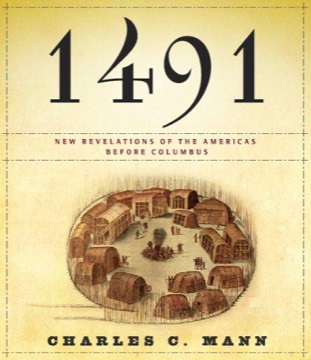
1491
New Revelations of the Americas Before Columbus
Charles Mann's synthesis of research on the Americas before European contact — arguing that the hemisphere was more populous, more urbanised and more environmentally managed than the standard account allows.
- First published
- 2005
- Publisher
- Knopf
- Pages
- 632
- Shelf
- History
- Level
- Core
- ISBN-13
- 9780307278180
Record checked against
Catalogue note
- Reads as
- ReflectiveChanges how you see rather than what you do.
- Level
- Core / BuildingAssumes general familiarity with the subject.
- Approach
- Theoretical
- Written for
- Readers of history, Readers with some grounding
- Ideas
Saved in this browser only — no account, nothing sent anywhere. My library
Read this if
- You want to know how we got here.
- You want a book that changes how you see things rather than what you do tomorrow.
- You know roughly how the subject works and want the fuller account.
What it is doing
Mann is a journalist synthesising several decades of archaeological, demographic and ecological research that had substantially revised the picture of the pre-contact Americas without reaching general readers.
His organising claim is that three assumptions — few people, recent arrival, untouched wilderness — are all wrong, and that each has been revised in the same direction by independent lines of evidence.
Three standard assumptions — few people, late arrival, untouched wilderness — revised in the same direction independently.
Devmark’s reading — not a quotation from the book
How many people
His treatment of the demographic debate, in which estimates of the pre-contact population have been revised upward substantially, with wide disagreement remaining between scholars.
He handles the uncertainty honestly, presenting the high and low estimates and the methods behind each rather than adopting a figure. The lower bound is still far above what was taught for most of the twentieth century.
Epidemic collapse
The mechanism that explains the discrepancy: introduced diseases moved ahead of European settlement, frequently reaching populations before any European did.
His argument is that many early European accounts describe a post-apocalyptic landscape and were mistaken for a normal one. What was recorded as sparse settlement was in several cases the aftermath of mortality on a scale with few parallels.
How long they had been there
His chapters on the peopling of the Americas, on the collapse of the Clovis- first consensus, and on sites indicating substantially earlier arrival.
The field has continued to move since publication, generally in the direction he describes. His account of how strongly the earlier consensus was defended is a useful case study in how archaeological paradigms change.
Cities and states
His treatment of the urban centres: Tenochtitlan's scale and sanitation compared with contemporary European cities, the Maya, the Inca administrative system, and Cahokia in the Mississippi valley.
His account of the Inca khipu — the knotted cord records, whose full information capacity remains undeciphered — is among the book's most interesting material and undermines the assumption that these were societies without records.
The managed landscape
His most consequential argument. The Amazon, the eastern woodlands and the plains were not wilderness but landscapes shaped over millennia by burning, planting, earthworks and selective cultivation.
His treatment of terra preta — the anthropogenic dark soils of the Amazon, far more fertile than the surrounding ground and created by human activity — is the strongest single piece of evidence, and the research on it has expanded considerably since.
The Amazon's dark earths were made by people. That single finding did more damage to the wilderness idea than any argument.
Devmark’s reading — not a quotation from the book
Maize
His chapter on the domestication of maize from teosinte, a plant it barely resembles, requiring a sequence of genetic changes that had no obvious intermediate benefit.
He presents it as possibly the most impressive feat of plant breeding in human history, and the genetics supporting the claim are among the more settled material in the book.
What the argument changes
If the landscape was managed, then restoring it to a pre-human state is incoherent as a conservation goal, because there was no such state within the relevant period.
Mann draws this out explicitly, and it is the book's most practically consequential implication. It has since become a live argument in conservation policy and in debates about indigenous land management.
Where it is contested
Specialists dispute particular claims, especially the highest population estimates and the extent of Amazonian modification, and some regard the synthesis as presenting contested positions with more confidence than the evidence supports.
Mann is generally careful to flag disagreement, but the cumulative effect of many revisionist findings presented together is more certain than any individual finding.
Its companion
Mann's *1493* covers what followed contact — the biological and economic exchange in both directions — and the two are designed to be read together.
This volume is the more surprising of the pair, because it revises a picture most readers did not know they were carrying.
What to take away
- 01Disease arrived before the EuropeansEarly accounts frequently described an aftermath and recorded it as the normal condition.
- 02The Amazon was farmedTerra preta soils are anthropogenic, which is the strongest evidence against the wilderness assumption.
- 03Maize is an extraordinary artefactDomesticated from a plant it barely resembles, through changes with no obvious intermediate benefit.
- 04Restoration has no target stateIf the landscape was managed for millennia, returning it to a pre-human condition is incoherent.
- 05The synthesis is surer than its partsIndividual findings are flagged as contested; their accumulation reads as more settled than it is.