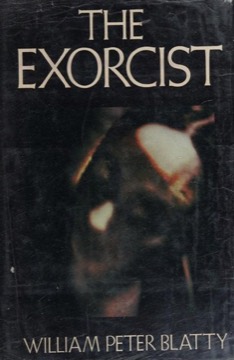
The Exorcist
William Peter Blatty's 1971 novel about the possession of a twelve-year-old girl in Washington, and the priest who is asked to confirm it.
- First published
- 1971
- Publisher
- HarperTorch
- Pages
- 400
- Shelf
- Thriller
- Level
- Core
- ISBN-13
- 9788412198867
Record checked against
Catalogue note
- Reads as
- ReflectiveChanges how you see rather than what you do.
- Level
- Core / BuildingAssumes general familiarity with the subject.
- Approach
- Theoretical
- Written for
- Readers who mean to stop at one more chapter, Readers with some grounding
- Ideas
Saved in this browser only — no account, nothing sent anywhere. My library
Read this if
- You want to be kept up late, and made uneasy about who to believe.
- You want a book that changes how you see things rather than what you do tomorrow.
- You know roughly how the subject works and want the fuller account.
The premise
Chris MacNeil, an actress filming in Georgetown, notices changes in her twelve-year-old daughter Regan: noises in the house, physical symptoms, changes in behaviour and eventually in speech.
Medical and psychiatric investigation produces nothing, and Chris is eventually directed toward the Church. Blatty structures the opening deliberately so that the reader spends a considerable time in an ordinary household before anything is clearly wrong.
Every test comes back normal, which is the point at which the Church is consulted.
Devmark’s reading — not a quotation from the book
Medicine first
A very substantial portion of the novel is spent on clinical investigation: neurological examinations, spinal taps, EEGs, psychiatric assessment, each described in procedural detail.
The exhaustiveness is the book's central strategy. By the time the supernatural is entertained, the reader has watched every alternative be eliminated at length.
Damien Karras
The Jesuit psychiatrist called to assess the case is in the middle of a crisis of faith and carrying guilt about his mother's death in poverty.
He is the novel's actual subject. The possession is the situation; Karras's inability to believe, and what it costs him, is what the book is about.
Doubt
Blatty was a practising Catholic and the novel is explicitly concerned with faith, but its protagonist spends almost the entire book unable to accept what he is seeing.
The refusal to make belief easy is what gives the book its weight. Karras looks for fraud and for psychiatric explanation until the last possible moment.
The detective
Lieutenant Kinderman, investigating a death near the house, provides a secular parallel investigation and much of the novel's humour.
His conversations with Karras are the best writing in the book, and Blatty returned to the character in a later novel and film. Kinderman is also used to keep a secular explanation permanently available, since he is investigating a death that has a perfectly ordinary set of possible causes.
Research
Blatty based the novel on a 1949 case of an exorcism performed on a boy in Maryland, which he learned about as a Georgetown student.
The Church material — the requirements for authorising an exorcism, the bureaucratic caution involved — is researched and is considerably more specific than the popular image of the subject.
The explicit material
The scenes involving Regan's desecration and obscenity were shocking in 1971 and remain difficult, and they are the element most people know about the book.
Blatty's justification is that the possession's strategy is degradation rather than terror, and the novel is coherent about this. It remains a great deal to read.
The mother
Chris MacNeil is drawn with real sympathy: a non-religious woman forced into a position she finds absurd, doing everything available and then everything unavailable.
Her characterisation is better than the novel's reputation suggests, and her scenes carry the domestic weight the theological material needs. Blatty gives her the practical burden throughout: the doctors, the money, the decisions, and the position of being the only person who can authorise anything.
Ambiguity
The novel maintains, longer than most readers remember, the possibility that the events have a psychiatric explanation.
Blatty does resolve it, and the length of the suspension is what distinguishes the book from the genre it created. Karras's own psychiatric training is used against the supernatural reading for most of the book, and he produces plausible alternative accounts of nearly everything he observes.
Prose
It is efficient and frequently plain, with the medical and procedural passages handled in a flat register and the dialogue carrying most of the characterisation.
Blatty was a comic screenwriter by background, and the timing in the conversational scenes is noticeably better than the descriptive writing.
The film
William Friedkin's 1973 adaptation, with a screenplay by Blatty, is among the most successful horror films made and has largely replaced the book in public memory.
The novel gives considerably more space to Karras's interiority and to the medical investigation, and is a slower and more argumentative work.
Who it is for
Readers who want horror organised around a genuine theological question, and who can tolerate extremely explicit content.
It is more serious than its reputation and considerably more procedural. The film's imagery has obscured a novel that is mostly about a man trying to find a rational explanation.
What to take away
- 01Every alternative eliminated firstExtensive neurological and psychiatric investigation means the supernatural is entertained only after the reader has watched everything else fail.
- 02A crisis of faith as the subjectThe possession is the situation; Karras's inability to believe and what that costs him is what the book examines.
- 03Degradation rather than terrorThe novel's account of possession is that its strategy is humiliation, which is coherent and still very difficult to read.
- 04Ambiguity sustainedThe psychiatric explanation is kept live far longer than most readers remember, which distinguishes it from its imitators.
- 05Bureaucratic caution documentedThe Church's requirements for authorising an exorcism are researched and are far more specific than the popular image.
- 06A secular parallelKinderman's police investigation runs alongside and supplies both the humour and a non-religious frame for the same events.