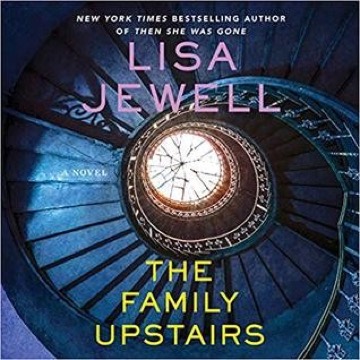
The Family Upstairs
Lisa Jewell's 2019 novel about a woman who inherits a Chelsea house on her twenty-fifth birthday and learns what happened in it before she was born.
- First published
- 2019
- Publisher
- Thorndike Press, a part of Gale, a Cengage Company
- Pages
- 464
- Shelf
- Thriller
- Level
- Entry
- ISBN-13
- 9781501190124
Record checked against
Catalogue note
- Reads as
- ReflectiveChanges how you see rather than what you do.
- Level
- Accessible / FoundationalNo prior reading assumed.
- Approach
- Theoretical
- Written for
- Readers who mean to stop at one more chapter, Newcomers to the subject
Saved in this browser only — no account, nothing sent anywhere. My library
Read this if
- You want to be kept up late, and made uneasy about who to believe.
- You want a life told honestly, at full length.
- You want a book that changes how you see things rather than what you do tomorrow.
- You are starting from scratch here and want a way in that assumes no prior reading.
The premise
Libby Jones receives a solicitor's letter on turning twenty-five: she has inherited a large house on Cheyne Walk. She was adopted as an infant and knows nothing about her origins.
Twenty-five years earlier, three adults were found dead in that house of apparent suicide, a baby was found alive upstairs, and four teenagers who lived there were never located.
Three bodies, a baby upstairs, and four missing teenagers nobody has seen in twenty-five years.
Devmark’s reading — not a quotation from the book
Three narratives
The novel runs Libby's present-day investigation, a woman in France searching for her own missing daughter, and Henry's retrospective account of growing up in the house.
Henry's narration carries most of the book and is by a considerable margin the most compelling of the three.
The cult
A charismatic man and his family move into the house as guests and progressively take control of it: the finances, the children's education, the food, and eventually the marriages.
The account of how this happens incrementally, with each concession reasonable in isolation, is the novel's best material.
Henry
The narrator of the historical sections is a teenager when the family arrives, intelligent, and increasingly aware that the adults are not going to act.
His voice is arch, retrospective and unreliable in a way that is disclosed carefully, and his account is the reason the book works.
Children without adults
The teenagers are progressively abandoned by parents who have been absorbed into the new arrangement, and the novel is precise about the specific horror of being failed by people who are still present.
This is more disturbing than the cult material itself. Jewell is also careful that the teenagers try, repeatedly and in ways an adult would recognise as reasonable, and that none of it works.
Pace
The three threads rotate rapidly with short chapters, and the two contemporary strands are considerably less interesting than the historical one.
Readers frequently report wanting to skip ahead to Henry's sections, which is a structural problem the novel does not fully solve. Jewell alternates strictly rather than giving Henry consecutive chapters, which maintains the rotation at the cost of the book's own momentum.
The house
The Chelsea property is described as both enormously valuable and progressively derelict, and the contrast is used well.
It is a good setting: a house worth millions in which children are malnourished, which makes the wealth itself part of the strangeness. Its value also drives the contemporary plot entirely, since the inheritance is what brings the surviving characters back into contact.
Sexual content
The novel involves the sexual exploitation of teenagers by adults in the household, handled without explicit description but centrally.
Readers should expect it. The material is the mechanism by which the household's control is exercised. Jewell handles it through implication and aftermath rather than depiction, and the restraint is consistent with her treatment of difficult material elsewhere.
The reveals
Several arrive in the final third and at least two are well prepared, with one turning on an identity the reader has been given sufficient information to guess.
The ending is more conventional than the historical material and resolves slightly too tidily. The identity of the third narrator in particular is guessable, and Jewell appears to intend it to be, since the pleasure is in confirmation rather than surprise.
Prose
Fluent and readable, with the historical sections written in a noticeably more distinctive voice than the contemporary ones.
The disparity is deliberate and is also the source of the pacing problem. Henry's arch, self-aware register is genuinely enjoyable to read, and the contemporary chapters' plainness is noticeable immediately after one of his.
The sequel
Jewell wrote a follow-up, The Family Remains, which continues several characters' stories.
The original stands alone completely, and readers who want a closed narrative can stop here without loss. It also revisits events from different perspectives, which some readers find enriching and others find a dilution of the original's ambiguity.
Who it is for
Readers who want a family mystery with a genuinely unsettling historical strand, and who can tolerate two weaker threads around it.
Henry's account alone would make a stronger book, and readers frustrated by the contemporary sections are responding to something real about the construction. It is also fast and very readable, and readers who want the historical strand can skim the contemporary chapters without losing the plot.
What to take away
- 01Incremental concessionThe household is taken over through a sequence of individually reasonable accommodations, which is the novel's best material.
- 02Failed by people still presentThe specific horror is parents who are physically there and have stopped acting, which is worse than abandonment.
- 03Wealth as part of the strangenessMalnourished children in a house worth millions makes the setting itself uncanny.
- 04One thread carrying the bookHenry's retrospective narration is far stronger than the two contemporary strands, which is a structural problem.
- 05Unreliability disclosed carefullyThe narrator's arch retrospective voice is revealed to be selective in ways the reader can check afterwards.
- 06Exploitation as the mechanismThe sexual abuse of the household's teenagers is how control is exercised rather than an incidental cruelty.