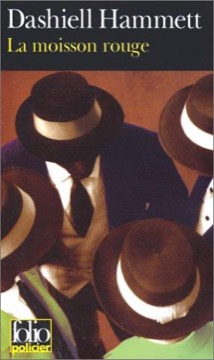
Red Harvest
Dashiell Hammett's 1929 first novel, in which a detective sets the criminal factions of a corrupt mining town against each other. The origin of a plot that has been retold for a century.
- First published
- 1929
- Publisher
- Librarie Gallimard
- Pages
- 225
- Shelf
- Thriller
- Level
- Core
- ISBN-13
- 9780785926542
Record checked against
Catalogue note
- Reads as
- ReflectiveChanges how you see rather than what you do.
- Level
- Core / BuildingAssumes general familiarity with the subject.
- Approach
- Theoretical
- Written for
- Readers who mean to stop at one more chapter, Readers with some grounding
- Ideas
Saved in this browser only — no account, nothing sent anywhere. My library
Read this if
- You want to be kept up late, and made uneasy about who to believe.
- You want a book that changes how you see things rather than what you do tomorrow.
- You know roughly how the subject works and want the fuller account.
The premise
The Continental Op arrives in Personville — called Poisonville by everyone who lives there — to meet a client who is murdered before they can speak.
The dead man's father, the mine owner who effectively owns the town, imported gangsters years earlier to break a strike and has never been able to get rid of them. The Op takes on the job of cleaning the place out.
The man who owns the town hired the criminals who took it from him.
Devmark’s reading — not a quotation from the book
The method
The Op has no legal authority and insufficient force, so he works by information: telling each faction a true or half-true thing about the others until they begin killing each other.
The book is a study in leverage. Almost every death results from a piece of knowledge placed in the right ear, and the Op's weapon is his understanding of who distrusts whom.
The Op himself
Unnamed, short, overweight and middle-aged, he is the anti-glamorous detective in his purest form — a salaried employee of a large agency with expenses to justify.
He is also the only Hammett protagonist who worries openly about what the work is doing to him. A late passage where he admits the killing has begun to appeal to him is the moral hinge of the novel.
Corruption with a cause
Personville is not vaguely corrupt; it is corrupt for a stated reason. Strikebreakers were brought in, the strike was broken, and the men hired for it stayed and took over the police, the papers and the city government.
Hammett, a former Pinkerton who had been asked to do such work, writes the economics with unusual precision. The violence has an origin in a labour dispute and never stops being about money.
Violence and volume
The body count is enormous and rises through the book until the killings become almost administrative — reported in lists, several to a paragraph.
The numbing is deliberate. By the final third the reader has stopped registering individual deaths, which is the state the Op himself describes reaching.
The prose
Flat, fast and declarative, with dialogue that carries almost all the characterisation. Hammett had been writing for Black Mask, and the chapters retain a serial shape with a turn at the end of each.
There is no lyricism at all, which distinguishes it sharply from Chandler. The effect is closer to a report filed by someone who does not expect to be asked how he felt.
Dinah Brand
A freelance operator who trades information for money and gifts, Dinah is the most vivid character in the book and the one the Op comes closest to trusting.
She is written without either idealisation or punishment-by-plot in the usual sense: she is careless, mercenary, physically unglamorous and entirely in control of her own dealings.
The moral question
The Op achieves his aim and the town is cleaned out, at a cost he cannot reckon and by methods indistinguishable from the ones he came to stop.
Hammett does not resolve it. The ending is procedural — a report to be written, an agency to answer to — and the absence of judgement is the judgement.
He wins by becoming an efficient version of the thing he was sent to remove.
Devmark’s reading — not a quotation from the book
The film descendants
The plot — a stranger playing two criminal factions against each other in a lawless town — reappears in Yojimbo, in A Fistful of Dollars, in Last Man Standing and in Miller's Crossing.
The chain of influence is much argued over and not always acknowledged, but the structure is unmistakable and this is its earliest full expression.
Its place in Hammett
It was his first novel, serialised in 1927-28, and it is the most violent and least shapely of the five. The Maltese Falcon is better constructed; this one is more alarming.
Readers who want Hammett's politics rather than his elegance should start here. It is the book where the connection between capital and organised violence is most explicit.
Difficulty
The cast is large, the factions shift, and the names arrive quickly. Several readers find the middle third hard to follow, and the book does not pause to recapitulate.
Keeping a rough note of who runs what is not a bad idea. The confusion is partly intended — the Op is also losing track — but it is a genuine obstacle.
Reading it now
It is short, brutal and considerably stranger than its reputation as a foundational text suggests. The mining-town setting and the labour history give it a specificity most crime fiction lacks.
Expect no detection. It is a novel about applied violence and about a man discovering he has a taste for it.
What to take away
- 01Violence by informationThe Op has no authority and no numbers, so he wins by placing true facts where they will do the most damage.
- 02Corruption with an originThe town is not vaguely rotten; strikebreakers were hired, stayed, and took over — the economics are specified.
- 03Numbing as designThe body count rises until deaths are reported in lists, putting the reader in the state the narrator describes.
- 04A detective who is compromisedThe Op admits the killing has started to appeal to him, which is the moral hinge and is never resolved.
- 05The two-factions plotA stranger setting rival gangs against each other reappears across a century of film, and this is its earliest full version.
- 06The report, not the reckoningIt ends with paperwork rather than judgement, and the refusal to moralise is the argument.