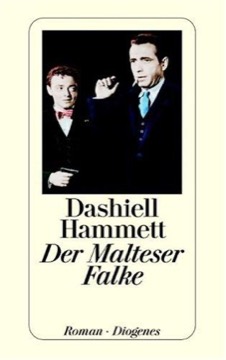
The Maltese Falcon
Dashiell Hammett's 1930 novel, in which a San Francisco private detective is drawn into a hunt for a jewelled statuette after his partner is killed. The book that defined the hardboiled detective.
- First published
- 1929
- Publisher
- Alianza Editorial
- Pages
- 254
- Shelf
- Thriller
- Level
- Core
- ISBN-13
- 9781471917684
Record checked against
Catalogue note
- Reads as
- ReflectiveChanges how you see rather than what you do.
- Level
- Core / BuildingAssumes general familiarity with the subject.
- Approach
- Theoretical
- Written for
- Readers who mean to stop at one more chapter, Readers with some grounding
Saved in this browser only — no account, nothing sent anywhere. My library
Read this if
- You want to be kept up late, and made uneasy about who to believe.
- You read for the writing as much as for the argument.
- You want a book that changes how you see things rather than what you do tomorrow.
- You know roughly how the subject works and want the fuller account.
The premise
A woman calling herself Miss Wonderly hires Sam Spade and his partner Miles Archer to follow a man. That night Archer is shot dead, and so is the man he was following.
The client's story collapses immediately, and Spade finds himself among several people who want the same object and are willing to lie, pay or kill for it.
The camera eye
Hammett's technique is the book's most radical feature: the narration reports only what could be observed from outside. Spade's face, posture and words are described; his thoughts never are.
The reader is therefore in the same position as every other character, unable to tell whether Spade is playing along or telling the truth. The plot's central uncertainty is created by a point-of-view decision rather than by concealment.
You are never told what he is thinking, which is exactly the problem everyone else has.
Devmark’s reading — not a quotation from the book
Spade
He is not a romantic figure. He was sleeping with his partner's wife, he handles his clients with contempt, and he pursues his own interest openly.
What he has instead of virtue is a professional rule, stated near the end and not before: when a man's partner is killed, something is expected of him. The code arrives as a fact about the trade, not as a moral position.
The supporting cast
Gutman, Cairo and Wilmer form one of the most durable assemblies in crime fiction — the voluble fat man, the perfumed fastidious one, and the young gunman who cannot be spoken to without losing his temper.
Each is drawn almost entirely through speech pattern and physical habit, which is the only tool the external narration allows.
Brigid
The client is a liar from her first appearance and continues lying after each exposure, which the novel treats as her method rather than as a flaw to be corrected.
The relationship between her and Spade is the book's real duel. Neither believes the other, both proceed anyway, and the ending turns on which of them was more willing to act on that.
The object
The falcon is a pure pretext — valuable, absent, and mostly discussed rather than seen. Hammett gives it a long spurious history in a single monologue and otherwise keeps it off the page.
It is the model for a whole class of narrative device: the thing everyone wants, whose properties do not matter, and whose function is to put incompatible people in the same room.
Hammett's own background
He had worked as a Pinkerton operative, and the novel's procedural confidence comes from that: the tailing, the hotel checks, the handling of police who are neither allies nor quite enemies.
He also brought a distrust of the agency's role in industrial disputes, which is part of why his detectives are employees with interests rather than knights.
The Flitcraft story
Spade tells a digressive anecdote about a man who walked away from his life after a falling beam nearly killed him, then rebuilt an almost identical one elsewhere.
It has nothing to do with the plot and is the philosophical centre of the book: people adjust to randomness and then revert to pattern. Its irrelevance is the reason it is remembered.
The dialogue
Almost everything is conveyed in speech, and the speech is stripped of attribution and commentary. Long exchanges run with nothing but names and the occasional gesture.
The influence on American prose beyond crime fiction is considerable. Hammett demonstrated how much could be carried by what people say when the narrator declines to interpret it.
The 1941 film
Huston's adaptation follows the novel closely — much of the dialogue is lifted directly — and Bogart's performance has largely replaced the book's Spade in public memory.
The novel's Spade is blonder, heavier and considerably less likeable. The film softens him, which changes the ending's meaning more than it changes its events.
What it established
The private detective as employee rather than gentleman, the plot driven by a coveted object, the refusal of interiority, and the flat American speech: all of it is here in finished form in a first-rank novel.
Chandler, Macdonald, Cain and most of what followed proceed from this book, and it remains the clearest single origin point the genre has.
Reading it now
It is short, almost entirely dialogue, and moves very fast. Nothing about it requires context, and the prose has dated less than almost any other novel of 1930.
The chief adjustment is the flatness: readers used to being told how a protagonist feels will have to infer it, which is the book asking to be read the way it was built.
What to take away
- 01Interiority withheldThe narration reports only what is observable, so the reader cannot tell what Spade intends — the same problem every character has.
- 02A code, not a conscienceSpade's rule about a dead partner is presented as a fact of the trade rather than as a moral principle.
- 03The pretext objectThe falcon is barely seen and its properties do not matter; its job is to put incompatible people in one room.
- 04Character through speech aloneWith interiority unavailable, Gutman, Cairo and Wilmer are built entirely from how they talk and move.
- 05The Flitcraft digressionAn anecdote with no bearing on the plot carries the book's actual argument: people adjust to randomness, then revert.
- 06Procedural authorityHammett's years as a Pinkerton operative supply the tailing, the hotel work and the wary handling of police.