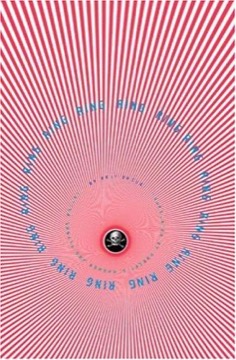
Ring
Koji Suzuki's 1991 novel about a videotape that kills its viewers a week after they watch it, and the journalist who has seven days to work out why. The origin of modern J-horror.
- First published
- 1991
- Publisher
- Pages
- 303
- Shelf
- Mystery
- Level
- Entry
- ISBN-13
- 9780007178841
Record checked against
Sources disagree on the publication year (openlibrary 1998, wikipedia 1991). The value shown is the one preferred by the most reliable source for original publication date; the disagreement is recorded rather than resolved.
Catalogue note
- Reads as
- ReflectiveChanges how you see rather than what you do.
- Level
- Accessible / FoundationalNo prior reading assumed.
- Approach
- Theoretical
- Written for
- Readers who want to be kept up late, Newcomers to the subject
- Ideas
Saved in this browser only — no account, nothing sent anywhere. My library
Read this if
- You want to be kept up late, and made uneasy about who to believe.
- You want a book that changes how you see things rather than what you do tomorrow.
- You are starting from scratch here and want a way in that assumes no prior reading.
The premise
Four teenagers die simultaneously of heart failure. Asakawa, a journalist and the uncle of one, traces them to a rented cabin and a tape: a sequence of disjointed images ending in a warning.
He watches it. He then has a week, and a young daughter, and a friend called Ryuji who is considerably stranger than he is.
The clock starts when the investigator becomes a victim, which is the structural trick.
Devmark’s reading — not a quotation from the book
What it actually is
The novel is closer to a detective procedural than to supernatural horror. Most of its length is investigation: records, interviews, a hospital archive, and a scientific hypothesis about how the tape could work.
Suzuki's original explanation is biological rather than purely spectral, and the mechanism is treated as something to be solved rather than endured.
It reads as an investigation with a deadline, not as a haunting.
Devmark’s reading — not a quotation from the book
Against the films
Hideo Nakata's 1998 adaptation changed the protagonist's gender, cut the scientific framing, and supplied the imagery the series is remembered for. The American remake followed the film, not the book.
The novel is consequently unfamiliar to most people who think they know the story, and its sequels move further toward science fiction than anyone expects.
Why it matters
It established the template that shaped two decades of horror: a cursed medium, a fixed deadline, and a curse that spreads by being passed on.
The last of those is the durable idea — a threat that can only be survived by transmitting it — and it is more disturbing on the page than on film.
A journalist, not a teenager
The protagonist is a married man in his thirties with a young daughter, working as a newspaper reporter, and the investigation proceeds through archives, newspaper morgues, interviews with elderly witnesses and a good deal of travel. The novel behaves throughout like procedural journalism with a deadline attached, which is a considerable distance from the teen-horror framing the films later acquired.
The deadline
The structure is a countdown and the book announces it constantly: seven days, with the remaining time stated at the head of sections, and an investigation that must produce a working answer rather than an understanding. It is the mechanism that keeps a novel containing almost no on-page violence continuously tense, because the threat is a date rather than a pursuer.
There is almost no violence in it. The tension is entirely a clock.
Devmark’s reading — not a quotation from the book
Ryuji
The friend recruited to help is a university philosophy lecturer who has privately confessed to serious crimes, and whose morality the novel pointedly refuses to resolve one way or the other. He is far darker and stranger than any of his screen counterparts, and his presence complicates the reader's sympathies throughout in ways every adaptation removed entirely.
Sadako as written
The origin explored in the second half is more science-fictional than supernatural — psychic research, a laboratory, an illness, a specific biological detail about the character that the films dropped. Suzuki's interest is in a mechanism rather than a haunting, which is the book's real departure from what followed.
The sequels change everything
The follow-up novels move decisively into virology, evolutionary biology and information theory, recasting the curse as something much closer to a self-replicating code seeking a host. Readers who assume the series is a conventional horror trilogy are frequently startled by where it goes, though the direction is entirely consistent with this first novel's rationalist instincts.
Why the films took over
The Japanese adaptation and its American remake made the well and the television screen globally famous and altered the story substantially: changing the protagonist's gender, dropping the scientific explanation and foregrounding the visual set piece. Nearly everyone knows the images and very few have read the book they came from.
What to take away
- 01A deadline, not a hauntingThe structure is a seven-day investigation.
- 02Procedural, not spectralMost of the book is records, interviews and hypothesis.
- 03A biological mechanismSuzuki's explanation is closer to science fiction than to ghosts.
- 04Not the filmThe 1998 adaptation changed protagonist, framing and imagery.
- 05Survive by transmittingThe curse that spreads by being passed on is the lasting idea.