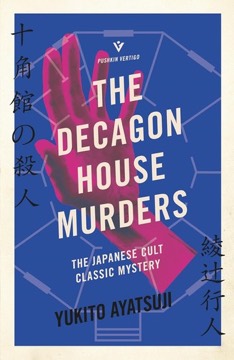
The Decagon House Murders
Yukito Ayatsuji's 1987 novel in which seven university mystery-club students spend a week on an island where four people died the previous year. The founding text of the shin honkaku movement.
- First published
- 1987
- Publisher
- Steerforth Press
- Pages
- 224
- Shelf
- Thriller
- Level
- Core
- ISBN-13
- 9781782276357
Record checked against
Sources disagree on the publication year (openlibrary 2021, wikidata 1987). The value shown is the one preferred by the most reliable source for original publication date; the disagreement is recorded rather than resolved.
Catalogue note
- Reads as
- ReflectiveChanges how you see rather than what you do.
- Level
- Core / BuildingAssumes general familiarity with the subject.
- Approach
- Theoretical
- Written for
- Readers who mean to stop at one more chapter, Readers with some grounding
- Ideas
Saved in this browser only — no account, nothing sent anywhere. My library
Read this if
- You want to be kept up late, and made uneasy about who to believe.
- You want a book that changes how you see things rather than what you do tomorrow.
- You know roughly how the subject works and want the fuller account.
The premise
Seven members of a university mystery club travel to Tsunojima, an island whose only remaining building is a ten-sided house. The previous year, the architect and three others died there.
They have given themselves nicknames after Western mystery writers. On the first morning they find seven plastic plates labelled first victim, second victim, and so on.
Seven students on an island, and seven plates on the table numbering them in order.
Devmark’s reading — not a quotation from the book
Shin honkaku
The novel launched a movement — new orthodox — committed to the fair-play puzzle mystery at a moment when Japanese crime fiction was dominated by social realism.
Its programme is explicit: the puzzle is the point, the clues must be supplied, and the reader is a competitor rather than an audience.
The Christie debt
The structure is openly modelled on And Then There Were None, and the characters discuss that novel directly.
Ayatsuji is not concealing the borrowing. The book's interest is in executing the same premise with a different solution, and the awareness is part of the design.
The dual structure
Chapters alternate between the island and a mainland investigation conducted by a former club member who receives an accusatory letter.
The mainland thread supplies the historical information the island thread cannot, and the convergence is the mechanism by which the reader is given what they need.
Characterisation
The students are thinly drawn and are distinguished mainly by their nicknames, which is a deliberate decision rather than a failure.
The novel is a puzzle and treats its cast as pieces. Readers wanting psychological depth are reading against the form's explicit intentions. The nicknames also serve a structural purpose that becomes apparent only at the solution, which is a defence of the thinness that the novel earns.
The single line
The solution turns on one sentence that reframes everything, delivered without emphasis partway through the book.
It is among the more celebrated moments in Japanese crime fiction, and its effectiveness depends entirely on the flatness with which it is placed. Ayatsuji has said he constructed the entire novel around it, which is plausible given how completely the rest of the book exists to make it possible.
Fair play
The clues are all present, the reader has everything required, and the solution does not depend on information withheld.
Verification on a second reading confirms this, and the novel's reputation rests on the rigour with which it keeps the contract. The movement's practitioners have generally maintained this discipline, and several later shin honkaku novels include explicit challenges to the reader.
The house
The decagonal building, with its ten-sided hall and identical rooms, is described precisely enough to be drawn, and the geometry matters.
Architecture is central to the movement generally, and several later shin honkaku novels are built around impossible buildings. Ayatsuji trained in architecture-adjacent study and returned to buildings repeatedly, and his later novels are known collectively for their houses.
Prose
Functional and unadorned in translation, prioritising clarity of information over any other quality.
The style is entirely subordinate to the puzzle, which is consistent with the movement's principles and will not suit readers who want writing. Readers arriving from literary crime fiction should adjust expectations accordingly, since the novel makes no attempt at atmosphere beyond what the puzzle requires.
Its influence
It began a movement that has produced several decades of work and has recently become available in English, including novels by Ayatsuji and others.
The shin honkaku novels now appearing in translation represent a substantial body of formally inventive crime fiction largely unknown to English readers until recently.
Translation
The English edition was published by Locked Room International, a small press specialising in impossible-crime fiction in translation.
Its existence is largely responsible for the movement's English-language visibility, and the edition includes a useful introduction on the context. Several further Ayatsuji novels and a substantial number of his contemporaries have since appeared in English through the same and similar imprints.
Who it is for
Readers who want a pure puzzle and are prepared to accept everything else being subordinated to it.
It is short and can be read in a sitting. Readers who want character or prose will find it austere to the point of bareness, which is entirely intentional.
What to take away
- 01A movement with a programmeShin honkaku committed to fair-play puzzles when Japanese crime fiction was dominated by social realism.
- 02The borrowing acknowledgedThe novel is openly modelled on Christie and has its characters discuss her, which is design rather than concealment.
- 03Characters as piecesThe thin characterisation is deliberate, and reading for psychological depth is reading against the form's stated intentions.
- 04One sentence, placed flatlyThe solution turns on a line delivered without emphasis, and its effectiveness depends entirely on that understatement.
- 05The contract keptEvery clue is supplied and nothing is withheld, and the novel's reputation rests on that rigour surviving verification.
- 06Architecture as the puzzleThe decagonal house is described precisely enough to be drawn, and the geometry is load-bearing.