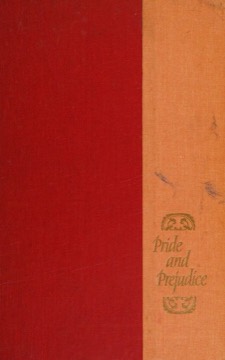
Pride and Prejudice
Jane Austen's novel of a family of five daughters, a small income and an entailed estate — a comedy of manners whose subject is the narrow economics of marriage and the difficulty of judging anyone accurately, including oneself.
- First published
- 1813
- Publisher
- T. Egerton, Whitehall
- Pages
- 351
- Shelf
- Fiction
- Level
- Core
- ISBN-13
- 9798749154306
Record checked against
Catalogue note
- Reads as
- ReflectiveChanges how you see rather than what you do.
- Level
- Core / BuildingAssumes general familiarity with the subject.
- Approach
- Theoretical
- Written for
- Readers of literature, Readers with some grounding
- Ideas
Saved in this browser only — no account, nothing sent anywhere. My library
Read this if
- You want to understand why people attach to each other the way they do.
- You want a book that changes how you see things rather than what you do tomorrow.
- You know roughly how the subject works and want the fuller account.
The situation
The Bennet family has five unmarried daughters, a modest income and an estate entailed away from the female line, meaning that on the father's death the property passes to a male cousin and the women are left dependent.
Everything in the novel proceeds from this. Marriage is not primarily a romantic question for these characters; it is the only available mechanism for economic survival, and the book treats it with the seriousness that implies.
Marriage here is not a romantic question but the only available route to economic survival for five women.
Devmark’s reading — not a quotation from the book
Elizabeth
The second daughter, intelligent, quick-witted and inclined to trust her own first readings of people — which is precisely what the novel is going to test.
Austen gives her the reader's sympathy and then systematically demonstrates that her judgements have been wrong, which is a difficult thing to do without losing the reader's affection for her. That the affection survives is the novel's central technical achievement.
Darcy and the first impression
The wealthy friend of Bingley, whose initial conduct at the assembly is rude in a way that Elizabeth never entirely forgets and that the novel never entirely excuses.
The original working title was *First Impressions*, and the change is informative. The novel is about the two named faults and their effects: Darcy's pride making him unreadable, Elizabeth's prejudice making her unwilling to revise.
Free indirect discourse
Austen's technical contribution, and the reason the novel reads as modern. The narration slips into a character's perspective and vocabulary without announcing the shift, so the reader receives Elizabeth's judgements in what appears to be the narrator's voice.
This is why the misjudgements are so effective. The reader is not watching someone be wrong; the reader is being wrong alongside her, which makes the correction land personally.
The letter
The novel's structural hinge. Darcy's written account of his conduct, delivered after the first proposal, forces Elizabeth to reread everything she has believed.
Her response — the recognition that she has been vain rather than perceptive, and that her confidence in her own discernment was the actual error — is the moment the book has been constructed to reach.
The other marriages
Charlotte Lucas's entirely unromantic acceptance of Mr Collins, Lydia's elopement and its forced repair, the Bennet parents' long-settled incompatibility, and the Gardiners as the one functioning partnership in the book.
Austen sets these around the central romance deliberately. Charlotte's choice in particular is presented without condemnation, as a reasonable decision by a woman of twenty-seven with no fortune and no alternative.
Charlotte's choice is not condemned. It is what a woman of twenty-seven with no fortune reasonably does.
Devmark’s reading — not a quotation from the book
The comedy
Mr Collins, Lady Catherine, Mrs Bennet and Mr Bennet's detached irony are sustained comic creations, and the book is genuinely funny.
The comedy is doing structural work rather than providing relief. Each comic figure represents a position on rank, money or propriety that the novel is examining, and the laughter is a form of argument.
What it is not
It is not a romance in the modern genre sense, and readers arriving from the adaptations sometimes find the book cooler than expected.
The emotional climaxes are brief and understated, much of the action is conversation, and Austen consistently declines to dramatise the moments a later novelist would build toward. The restraint is deliberate.
Its reputation and the argument about it
It has been continuously popular for two centuries and continuously dismissed as domestic and limited — a charge made by Charlotte Brontë among others, and answered by the observation that the domestic sphere was where these characters' entire economic fate was decided.
The modern critical position treats Austen as a sharp social analyst whose narrow setting was a choice, not a limitation, and the novel's attention to income, entailment and dependency supports that reading.
How to read it
Slowly enough to hear the irony, which is carried in sentence construction rather than in signalled jokes, and with attention to how much of each character's speech is self-exposure.
The second reading is considerably better than the first, because the misdirections are visible and the technique becomes apparent once the plot is no longer supplying suspense.
What to take away
- 01The entail is the engineFive daughters and an estate passing to a male cousin is the economic fact everything else follows from.
- 02The reader misjudges alongside herFree indirect discourse delivers Elizabeth's errors in the narrator's apparent voice, so the correction stings.
- 03Pride and prejudice are both hers and hisThe original title was First Impressions, and the novel is about the difficulty of revising one.
- 04Charlotte is not punishedHer unromantic acceptance is presented as a rational decision under the conditions available to her.
- 05The comedy is argumentEach comic figure holds a position on rank or money that the book is examining through them.