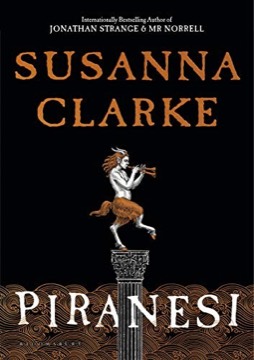
Piranesi
Susanna Clarke's short novel narrated by a man who lives in an endless house of statues, flooded by tides, and who believes there are fifteen people in the world, thirteen of them dead.
- First published
- 2020
- Publisher
- BLOOMSBURY
- Pages
- 272
- Shelf
- Fiction
- Level
- Core
- ISBN-13
- 9781526622440
Record checked against
Catalogue note
- Reads as
- ReflectiveChanges how you see rather than what you do.
- Level
- Core / BuildingAssumes general familiarity with the subject.
- Approach
- Theoretical
- Written for
- Readers of literature, Readers with some grounding
Saved in this browser only — no account, nothing sent anywhere. My library
Read this if
- You read for the writing as much as for the argument.
- You want a book that changes how you see things rather than what you do tomorrow.
- You know roughly how the subject works and want the fuller account.
The premise
The narrator calls himself Piranesi, though he does not think that is his name. He lives in a vast classical House of halls and vestibules filled with statues, with an ocean in the lower levels and clouds in the upper.
He keeps meticulous journals, fishes, maps the tides, and meets one other living person twice a week, whom he calls the Other. He is entirely content.
He is completely happy, which is the first thing the reader has to reconcile with everything else.
Devmark’s reading — not a quotation from the book
How it works
Clarke gives the reader information the narrator has recorded but does not understand, in his own journals. The reconstruction happens in the gap between his notes and his interpretation of them.
It is extremely controlled. The book is short, the register never breaks, and the narrator's kindness and wonder are sustained even as the reader's understanding of his situation darkens.
The journals contain everything you need; the narrator has simply not drawn the conclusions.
Devmark’s reading — not a quotation from the book
What it is about
The House is drawn from Piranesi's Carceri engravings and from Lewis's Narnia, and the novel is partly about the cost of the kind of knowledge that treats the world as a resource.
It is also, and more quietly, about recovery. Clarke wrote it during a long chronic illness after Jonathan Strange & Mr Norrell, and the book's attention to small daily observation has that behind it.
Reading it
Very short, very strange, and best approached knowing nothing. It rewards a reader willing to sit inside the narrator's world before wanting it explained.
Nothing else reads quite like it, including Clarke's own earlier novel.
It won the Women's Prize and was written after a sixteen-year gap in which Clarke published almost nothing, which is part of why its scale is so different from her first novel's.
The House
The setting is an infinite classical building of halls and statues, with an ocean in the lower levels and clouds in the upper, and tides that flood the staircases on a schedule the narrator has learned to predict. It is described with such calm practicality that the reader accepts it long before understanding what it is.
The journals
The novel is told through numbered notebook entries with a dating system the narrator invented himself. The form matters: he is a meticulous scientist recording a world, and the reader gradually notices discrepancies between what he writes and what the earlier volumes contain — which is where the book's tension actually lives.
He is a careful, honest record-keeper. The trouble is with the records, not with him.
Devmark’s reading — not a quotation from the book
Two people in a world
For most of the book the only other living person is a visitor who arrives twice a week for an hour, gives instructions, and shows no curiosity about the narrator's life. The relationship is drawn so lightly that its real character becomes apparent to the reader well before it becomes apparent to Piranesi.
The name
He is called Piranesi by the other man, and states plainly that he does not believe it is his name. The reference is to an eighteenth-century artist known for engravings of vast imaginary prisons, and it is a clue offered openly on the first pages to a reader who may not catch it.
Where the ideas come from
Clarke draws on a strand of thought about a lost way of knowing the world, and on a children's fantasy in which a house between worlds contains pools leading to others. The book is a distillation of that tradition rather than a pastiche of it, and it wears the influences lightly.
Innocence as the subject
The novel's real argument concerns what Piranesi has: a life of complete attention, gratitude and care for a world that gives him almost nothing. The question the ending poses is whether that state is worth more than what would be required to leave it, and Clarke does not answer tidily.
What to take away
- 01A contented narratorHis happiness is genuine and is the reader's first problem.
- 02Journals as evidenceHe records what he cannot interpret; you can.
- 03Carceri and NarniaThe House drawn from Piranesi's engravings and from Lewis.
- 04Knowledge as extractionThe cost of treating the world as a resource.
- 05Written through illnessClarke's long convalescence is behind its attention to small things.