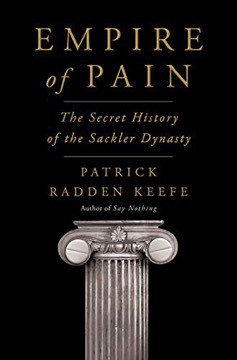
Empire of Pain
Patrick Radden Keefe's history of the Sackler family and Purdue Pharma — three generations, the marketing of OxyContin, and the construction of a reputation that the source of the money was designed not to touch.
- First published
- 2021
- Publisher
- Pan Macmillan
- Pages
- 720
- Shelf
- History
- Level
- Core
- ISBN-13
- 9780593416280
Record checked against
Catalogue note
- Reads as
- ReflectiveChanges how you see rather than what you do.
- Level
- Core / BuildingAssumes general familiarity with the subject.
- Approach
- Theoretical
- Written for
- Readers of history, Readers with some grounding
Saved in this browser only — no account, nothing sent anywhere. My library
Read this if
- You are starting or growing a company and want the unglamorous parts.
- You want to understand living things by how they came to be.
- You want a book that changes how you see things rather than what you do tomorrow.
- You know roughly how the subject works and want the fuller account.
The three generations
Keefe structures the book around Arthur Sackler and his brothers, the second generation who ran Purdue during the OxyContin years, and the third who were on the board as the litigation arrived.
The structure carries the argument: the methods that made the family wealthy were developed a generation before the drug that made them notorious, and the continuity is the point.
The methods that produced OxyContin's marketing were developed a generation before the drug existed.
Devmark’s reading — not a quotation from the book
Arthur and the invention of pharmaceutical marketing
The book's most important and least known material. Arthur Sackler essentially created modern pharmaceutical advertising: physician-targeted campaigns, the use of medical journals, sponsored research, and relationships with regulators and publications that blurred every boundary.
His work on Valium and the campaign that made it the most widely prescribed drug of its era established the template. Keefe's argument is that the OxyContin campaign was not an innovation but an application.
The name on the buildings
His parallel thread: the systematic purchase of institutional prestige — wings at major museums, university departments, galleries — attached to the family name while the company name was kept separate.
The separation was deliberate and it worked. For decades the public associated the name with philanthropy and had no idea of the source, which is precisely the outcome the arrangement was designed to produce.
OxyContin and the claim
His account of the drug's launch and of the central marketing claim: that the controlled-release formulation made addiction rare in pain patients.
The evidence base for that claim was extraordinarily thin, resting substantially on a brief letter to a journal that was not a study. Keefe traces how a thin citation became an established medical fact through repetition in company-sponsored material.
The sales operation
His documentation of the commercial machinery: sales representatives targeting high prescribers, the identification of doctors running pill mills as valuable customers rather than as a problem, and the incentive structures driving dose escalation.
The internal documents are the book's foundation here, and they show knowledge of misuse inside the company considerably earlier than its public position acknowledged.
The 2007 plea and what followed
His account of the federal case that ended in a guilty plea by the company and three executives, substantial fines, and no individual from the family facing charges.
His argument is that the settlement functioned as a cost of business: the company continued selling the drug, the marketing continued in modified form, and the deaths continued to rise for another decade.
The settlement operated as a cost of doing business. The drug stayed on the market and the deaths kept rising.
Devmark’s reading — not a quotation from the book
The bankruptcy and the shield
His treatment of the Purdue bankruptcy and the proposed settlement in which family members would receive releases from civil liability without the family itself filing for bankruptcy.
The mechanism — third-party releases in a corporate bankruptcy — is technical and consequential, and Keefe explains it clearly. It has since been the subject of substantial litigation and legislative attention.
The family's response
Keefe documents the family's public position: that they were not involved in day-to-day operations, that the crisis had other causes, and that the drug was approved and regulated.
He also documents the legal pressure applied to him and to other journalists during the reporting. The family's representatives disputed the book's characterisations, and Keefe's sourcing is extensive and documented.
What it is not
It is not a history of the opioid crisis. Other manufacturers, distributors, pharmacy chains, regulators and prescribers all bear responsibility, and the crisis moved to heroin and fentanyl in ways this book covers only glancingly.
Keefe is explicit that he is telling one family's story, and a reader should not take it as the full account of how the crisis happened.
Why it matters beyond the case
As a study in how a reputation is constructed and maintained separately from its source of funds, and in how institutions accept money without asking questions they could have asked.
And as documentation of how thin evidence becomes settled medical fact through funded repetition — a mechanism with applications far beyond this drug.
What to take away
- 01The marketing was invented a generation earlierArthur Sackler's physician-targeted methods created the template that OxyContin's campaign applied.
- 02The name and the company were kept apartDeliberately, and it worked for decades, which is what the philanthropy was structured to achieve.
- 03A letter became a factThe low-addiction claim rested on a brief journal letter that was not a study, established by repetition.
- 04Settlement as a line itemThe 2007 plea did not stop the sales, the marketing or the deaths.
- 05It is one family, not the whole crisisDistributors, pharmacies, regulators and other manufacturers are largely outside this book's frame.