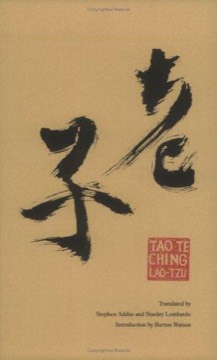
Tao Te Ching
A short classical Chinese text of eighty-one brief chapters, traditionally attributed to Laozi, which argues for effectiveness through yielding rather than forcing — and which is deliberately constructed so that it cannot be reduced to instructions.
- Composed
- not established
- Publisher
- not established
- Pages
- not established
- Shelf
- Philosophy
- Level
- Core
- ISBN-13
- not established
Record checked against
This work predates printing, so it has no publication year. The years the sources report — none — are those of later editions or translations, not of the work. No page count is recorded, so no reading estimate is shown for the book itself.
Catalogue note
- Reads as
- ReflectiveChanges how you see rather than what you do.
- Level
- Core / BuildingAssumes general familiarity with the subject.
- Approach
- Theoretical
- Written for
- Reflective readers, Readers with some grounding
- Ideas
Saved in this browser only — no account, nothing sent anywhere. My library
Read this if
- You want to examine an assumption you have never examined.
- You want a book that changes how you see things rather than what you do tomorrow.
- You know roughly how the subject works and want the fuller account.
What the text is
Eighty-one chapters, most only a few lines, in compressed and often deliberately ambiguous classical Chinese. It is traditionally attributed to Laozi, a figure whose historical existence is uncertain, and modern scholarship generally treats it as a compiled text that reached its current form around the fourth to third century BCE.
It is not a treatise and does not argue in the Western sense. It states, contradicts, and circles, and the circling is part of the method rather than a defect of it.
It does not build an argument. It approaches the same thing from eighty-one angles and lets you triangulate.
Devmark’s reading — not a quotation from the book
The untranslatable opening
The first line says, in most renderings, that the way that can be spoken is not the constant way. This is not throat-clearing; it is a warning about everything that follows, including itself.
The claim is that the most fundamental thing cannot be captured in categories, because categories work by exclusion. Any reader who wants a definition of the Tao has already been told, in the first sentence, that one is not available.
Wu wei
The central practical concept, usually rendered as non-action, which misleads almost everyone. It does not mean doing nothing. It means action that does not strain against the grain of a situation — the difference between forcing a door and finding it was hinged the other way.
The recurring images are water, which yields and outlasts stone; the empty hub that makes a wheel useful; the uncarved block whose value is its potential. All argue that effectiveness often comes from restraint rather than exertion.
On opposites
The text repeatedly observes that opposites define each other: long and short, difficult and easy, high and low are not independent properties but mutually constituting.
The practical consequence is a scepticism about striving for one pole. Push hard in any direction and the opposite is generated — a claim that reads as mysticism until you have watched an organisation's crackdown produce exactly the behaviour it forbade.
On leadership
A substantial portion addresses rulers directly, and it is the most transferable material in the text. The best leader is barely known to exist; the next is loved; the next feared; the worst is despised.
The recurring advice is to lead from behind, to claim no credit, and to let people believe the achievement was their own. This is not modesty as a virtue but as a technique: authority that constantly asserts itself generates resistance, and resistance is the thing being managed.
The highest leadership is the kind people experience as having happened by itself.
Devmark’s reading — not a quotation from the book
Emptiness and usefulness
One of the text's most concrete arguments: a room is useful because of the space, a pot because of the hollow, a wheel because of the gap at the hub. What is there gives form; what is absent gives function.
Applied to work and to attention, this is an argument for deliberately maintained slack. A schedule with no gaps and a plan with no give have been optimised into uselessness, which is a thoroughly modern conclusion arrived at very early.
On desire and sufficiency
A recurring theme is that wanting more is self-perpetuating, and that the person who knows what is enough is wealthy regardless of holdings.
The text is not ascetic; it is not arguing against having things. The argument is about the relationship between striving and satisfaction — that the pursuit itself generates the insufficiency it is trying to close, which is a structural claim rather than a moral one.
Translation is the whole problem
No classical text is more translation-dependent. Classical Chinese omits number, tense and often subject, and the Tao Te Ching exploits that ambiguity deliberately.
The practical consequence is that different translations are not stylistic variants but genuinely different readings — some scholarly and austere, some free interpretations that add material. Anyone serious should read at least two, and should check whether a translator worked from the Chinese or adapted an earlier English version.
How it is misused
Its aphoristic form makes it very easy to quote in support of almost anything, and the passivity reading — that one should simply not act — is the commonest error. Wu wei is a claim about *how* to act, not whether.
It has also been absorbed into a great deal of loose writing about mindfulness and leadership, often via paraphrases several removes from any translation. The text itself is stranger, sparer and less comforting than most of what is attributed to it.
How to read it
Not straight through, and not for conclusions. It works as something returned to, where a chapter that meant nothing on one reading opens on another — which is a property of the compression rather than mystification.
The most useful stance is to treat it as a corrective rather than a system. It is arguing against a specific default — that more force, more intervention and more assertion produce better outcomes — and it is most valuable to whoever is furthest inside that default.
What to take away
- 01Wu wei is about how, not whetherNot inaction. Action that does not strain against the grain of the situation.
- 02Force generates its oppositePush hard in one direction and the reaction appears; most crackdowns produce the behaviour they forbid.
- 03Emptiness is the functionA wheel works because of the gap at the hub. A plan with no slack has been optimised into uselessness.
- 04Lead so it seems to have happened by itselfAuthority that constantly asserts itself manufactures the resistance it then has to manage.
- 05Read two translationsClassical Chinese omits subject, number and tense; translations are different readings, not different styles.