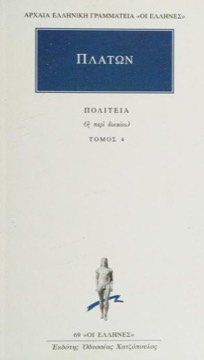
The Republic
Plato's dialogue on justice, which begins by asking what a just person is and answers by constructing an entire city — the founding text of Western political philosophy and the source of most of its enduring questions.
- Composed
- not established
- Publisher
- not established
- Pages
- 397
- Shelf
- Philosophy
- Level
- Deep
- ISBN-13
- not established
Record checked against
This work predates printing, so it has no publication year. The years the sources report — wikidata 1963, openlibrary 1554 — are those of later editions or translations, not of the work.
Catalogue note
- Reads as
- FoundationThe standard first book on its subject.
- Level
- Advanced / AdvancedAssumes you have read around the subject already.
- Approach
- Balanced
- Written for
- Reflective readers, Specialists and serious readers
Saved in this browser only — no account, nothing sent anywhere. My library
Read this if
- You want to understand how power is taken, kept and lost.
- You want to think harder about what is actually right.
- You want the book people are sent to first on this subject.
- You have read around this already and want a book that assumes it.
How it starts
With a straightforward question and a series of unsatisfactory answers. Justice is telling the truth and paying debts, says one speaker. Helping friends and harming enemies, says another. Then Thrasymachus asserts that justice is nothing but the advantage of the stronger.
Thrasymachus is the real opponent. His position — that talk of justice is a cover for power, and that the unjust person who escapes detection lives better — is the challenge the remaining nine books are constructed to answer, and it has never gone away.
Thrasymachus is the real opponent. That justice is a cover for power is the challenge the whole work answers.
Devmark’s reading — not a quotation from the book
The city as a magnified soul
Socrates's method: justice in a single person is hard to see, so examine it written large in a city, then read the findings back.
The analogy is doing enormous argumentative work and it is the move most often challenged. Whether a city and a soul have the same structure is assumed rather than established, and much of the criticism of the work's politics follows from accepting it.
The three parts and the four virtues
His resulting structure: a city has producers, guardians and rulers; a soul has appetite, spirit and reason. Wisdom, courage, moderation and justice each belong to a part or to the relationship between them.
Justice, on this account, is each part doing its own work and not another's. It is an internal harmony rather than a set of actions, which is why Socrates can claim that the just person benefits from justice regardless of whether anyone notices.
The guardians and the controversial arrangements
The proposals that make modern readers uncomfortable: censorship of poetry and music, communal families among the guardian class, eugenic breeding, the noble lie told to secure the social order, and the abolition of private property for rulers.
They must be read honestly rather than softened. Some readers take them as serious proposals, others as deliberate provocations or as reductions meant to expose the cost of the premise. The text does not settle it.
Women, and the surprising passage
Socrates argues that women of the guardian class should receive the same education and hold the same roles, on the grounds that the relevant differences between individuals do not track sex.
The argument is genuinely striking for its time and place, and it sits inside a proposal that also abolishes the family. Reading it as an early feminist argument requires ignoring the context; ignoring it entirely requires dismissing what the text plainly says.
The three images
The philosophical centre: the Sun, the Divided Line and the Cave. The Good is to knowledge what the sun is to sight. The line divides appearance from reality and opinion from knowledge. The cave shows what happens to someone who leaves and returns.
The Cave is the most widely known passage in philosophy and the most frequently flattened. Its sting is in the ending, where the prisoner who returns with knowledge is mocked and would be killed — which the reader is meant to connect to what Athens did to Socrates.
The Cave's sting is its ending: the returning prisoner is mocked and would be killed. Athens had done exactly that.
Devmark’s reading — not a quotation from the book
The philosopher-king
The proposal that cities will not cease from evil until philosophers rule or rulers philosophise, and the argument from the ship of state that navigation is a skill and government should be too.
Its objection is the obvious one and Plato anticipates it: the argument assumes the expertise exists and can be identified, and the twentieth century produced several regimes claiming exactly that qualification.
The decline of regimes
Books eight and nine, tracing the degeneration from aristocracy through timocracy, oligarchy and democracy to tyranny, with a corresponding personality type for each.
His account of how democracy produces tyranny — through the collapse of all restraint into a licence that makes people receptive to a strongman promising order — is the passage most often cited in modern political commentary, and it is uncomfortably well observed.
Popper's charge
Karl Popper's argument that the work is the foundational text of totalitarianism, with its closed society, its rigid classes, its state control of information and its hostility to change.
The charge is serious and widely contested. The defence is that it is a dialogue rather than a manifesto, that the city is an image for the soul, and that Socrates repeatedly signals the construction is unrealisable. A reader should encounter both readings rather than one.
How to read it
Not as a set of conclusions but as an argument in motion, with a question asked in the first pages that is never quite answered to the satisfaction of anyone in the room.
Its value is that almost every subsequent question in political philosophy — what justice is, who should rule, what education is for, whether the good life and the successful life are the same — is already present in it, posed more sharply than in most of what came after.
What to take away
- 01Justice as each part doing its own workAn internal harmony rather than a set of actions, which is how it can benefit the just person unobserved.
- 02The city magnifies the soulThe analogy carries enormous argumentative weight and is assumed rather than established.
- 03The Cave ends badlyThe returning prisoner is mocked and threatened, which connects directly to Socrates's own fate.
- 04Democracy's licence invites tyrannyHis account of the collapse of restraint into receptiveness to a strongman remains uncomfortably apt.
- 05Read Popper's charge alongside itWhether this is a blueprint for a closed society or an image of the soul is genuinely contested.