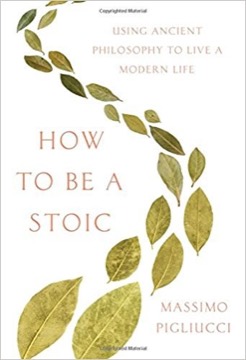
How to Be a Stoic
Using Ancient Philosophy to Live a Modern Life.
Massimo Pigliucci's introduction to Stoicism as a working philosophy, framed as an imagined conversation with Epictetus and grounded in the author's own move from Catholicism to atheism to Stoic practice.
- First published
- 2017
- Publisher
- Penguin Random House
- Pages
- 288
- Shelf
- Philosophy
- Level
- Entry
- ISBN-13
- 9780465097951
Record checked against
Only one source carried a publication date for this work, so the year is uncorroborated.
Catalogue note
- Reads as
- PracticalWritten to be applied, not only understood.
- Level
- Accessible / FoundationalNo prior reading assumed.
- Approach
- Practical
- Written for
- Reflective readers, Newcomers to the subject
- Ideas
Saved in this browser only — no account, nothing sent anywhere. My library
Read this if
- You want a practical philosophy for things outside your control.
- You want something to apply, not only something to think about.
- You are starting from scratch here and want a way in that assumes no prior reading.
The framing
Pigliucci is a philosopher of science who came to Stoicism looking for a practical framework compatible with a scientific worldview. The book is structured as a dialogue with Epictetus, the freed slave whose Discourses are the most usable of the surviving Stoic texts.
He organises around the three disciplines Epictetus set out: desire, action and assent — what to want, how to behave, and what to believe.
The three disciplines are what to want, how to act, and what to accept as true.
Devmark’s reading — not a quotation from the book
The core distinction
Everything rests on the dichotomy of control: some things are up to us — judgements, intentions, responses — and most things are not. Stoic practice is the repeated work of assigning each situation correctly.
Pigliucci is careful about the usual misreading. Stoicism does not counsel indifference to outcomes; it counsels acting fully while holding the result lightly, which is a harder position than detachment.
What is useful
The practical chapters cover handling insult, illness, anger and death, and include the classical exercises: negative visualisation, the view from above, and the evening review of the day's judgements.
He also deals honestly with where Stoic metaphysics no longer holds — the providential universe of the ancient Stoics is not available to a modern reader — and argues the ethics survive the loss.
The ancient physics is gone; Pigliucci's case is that the ethics do not depend on it.
Devmark’s reading — not a quotation from the book
Epictetus as interlocutor
Pigliucci structures the book as an imagined conversation with Epictetus, walking through modern problems and asking what the ancient answer would be. The device keeps the philosophy applied rather than expository, and it positions the reader as a student rather than as a scholar of the texts.
The three disciplines
Beyond the dichotomy of control, he organises practice around desire — wanting appropriately; action — behaving well toward others; and assent — judging what is actually the case before reacting to it. The three-part scheme comes from the ancient material and is more useful than the single slogan the philosophy is usually reduced to.
What Stoicism claims about virtue
Pigliucci is careful about the thing modern popularisations tend to drop: classical Stoicism holds that virtue is the only genuine good and everything else — health, wealth, reputation — is preferred but indifferent. He is honest that this is a demanding metaphysical commitment and that most contemporary practitioners quietly decline it.
The ancient claim is that only virtue is good. Most modern Stoics accept the techniques and skip that sentence.
Devmark’s reading — not a quotation from the book
Role ethics
A useful chapter covers the Stoic account of duties arising from the roles a person occupies — citizen, parent, colleague, human being — and the idea of concentric circles of concern to be deliberately drawn inward. It is the part of the philosophy that answers the charge of self-absorbed detachment.
The practical chapters
The applied material covers insult, illness, anger, disability, death and the question of when to leave a situation. Pigliucci draws on his own life throughout, including a mugging and his father's death, which keeps the advice tethered to circumstances rather than staying in the abstract.
A scientist's Stoicism
As a philosopher of science and a former biologist, Pigliucci is explicit about which parts of the ancient system he is discarding — the providential cosmology, the physics — and why he thinks the ethics survives detached from it. Whether that detachment is legitimate is an open question within the field, and he acknowledges it.
What to take from it
It is the most philosophically careful of the popular introductions, and it is better than any of them at distinguishing what the Stoics actually argued from what contemporary self-help has since made of them. Read it alongside Epictetus rather than instead of him, which is what Pigliucci explicitly recommends, and treat the chapter on virtue as the test of whether you are adopting a philosophy or borrowing a set of coping techniques.
What to take away
- 01Three disciplinesDesire, action and assent, taken from Epictetus.
- 02The dichotomy of controlSorting what is yours from what is not, repeatedly.
- 03Not detachmentAct fully, hold the outcome lightly — harder than indifference.
- 04Classical exercisesNegative visualisation, the view from above, the evening review.
- 05Ethics without the physicsThe ancient cosmology is dropped and the practice survives.