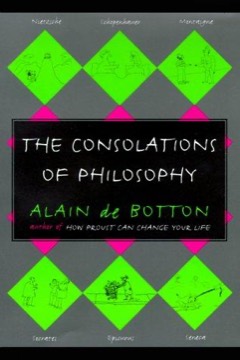
The Consolations of Philosophy
Alain de Botton's application of six philosophers to six ordinary difficulties: unpopularity, poverty, frustration, inadequacy, a broken heart and hardship.
- First published
- 2000
- Publisher
- Vintage Books
- Pages
- 264
- Shelf
- Philosophy
- Level
- Entry
- ISBN-13
- 9780786167371
Record checked against
Catalogue note
- Reads as
- ReflectiveChanges how you see rather than what you do.
- Level
- Accessible / FoundationalNo prior reading assumed.
- Approach
- Theoretical
- Written for
- Reflective readers, Newcomers to the subject
- Ideas
Saved in this browser only — no account, nothing sent anywhere. My library
Read this if
- You want to examine an assumption you have never examined.
- You want a book that changes how you see things rather than what you do tomorrow.
- You are starting from scratch here and want a way in that assumes no prior reading.
The structure
Six chapters, each pairing a problem with a philosopher. Socrates on being unpopular. Epicurus on not having money. Seneca on frustration. Montaigne on feeling inadequate. Schopenhauer on a broken heart. Nietzsche on difficulty.
The pairings are the book's device and they are chosen well: each philosopher is used for the thing they actually addressed rather than as a general authority.
Six problems, six philosophers, each used for the difficulty they genuinely wrote about.
Devmark’s reading — not a quotation from the book
What it does
De Botton's method is biographical and practical. He gives enough of each life to make the ideas legible, then applies them directly to situations a reader will recognise.
The Montaigne chapter is the strongest: his argument that the body's indignities and one's own ordinariness are proper philosophical subjects is delivered through Montaigne's own preoccupation with exactly that.
Its position
This is philosophy as therapy rather than as analysis — the classical conception, which de Botton is explicitly reviving against the academic one.
Professional philosophers have objected that it simplifies and that the consolatory frame distorts several of the figures, particularly Nietzsche and Schopenhauer. The objection is fair; so is de Botton's reply that the academy abandoned a use philosophy had for two thousand years.
Academics object that it simplifies. His reply is that philosophy had this use for two millennia.
Devmark’s reading — not a quotation from the book
How it reads
Illustrated, conversational and short. It is a good first philosophy book for a reader who has bounced off primary texts, and a poor substitute for them afterwards.
Epicurus on what money actually buys — friends, freedom, thought, rather than possessions — is the chapter most readers remember.
The six pairings
Each chapter attaches one philosopher to one ordinary difficulty: Socrates on being unpopular, Epicurus on having little money, Seneca on frustration, Montaigne on feeling inadequate, Schopenhauer on a broken heart, and Nietzsche on hardship. The structure is the book's argument — that philosophy was originally addressed to precisely these problems.
Epicurus, corrected
The chapter that most changes a reader's assumptions concerns the philosopher whose name became a synonym for luxury, and who in fact argued for a very short list of genuine requirements: friends, freedom, thought, and enough food. De Botton uses him to separate what we want from what actually produces satisfaction.
The man whose name means indulgence thought you needed friends, freedom, and something to think about.
Devmark’s reading — not a quotation from the book
Montaigne on the body
The material on inadequacy concentrates on embarrassment — the body, its functions, the gap between how a life is presented and how it is lived — and on Montaigne's decision to write about all of it plainly. The argument is that much suffering comes from believing your ordinary condition is an aberration.
Schopenhauer on being left
The chapter on a broken heart uses a philosopher who explained romantic attachment as a biological drive with no regard for individual happiness. The consolation is unexpected: that the pain is impersonal, that it was never about your merits, and that the force operating through you did not have your interests in view.
The pictures
The book is illustrated throughout with portraits, manuscripts, photographs and objects, and the visual material is doing deliberate work — locating the philosophers as people who lived somewhere, ate something and had faces, which is central to the argument that they were addressing lives rather than producing systems.
What philosophers object to
Academic readers have objected that the treatment is selective, that each thinker is reduced to whichever doctrine fits the chapter's problem, and that the wider systems are dropped. That criticism is fair as a description and misses the intent: the book is a work of popularisation making a case for philosophy's usefulness, not a survey.
What to take from it
It is the most accessible possible entry point and it is honest about being one. Its best effect is to send readers to the primary texts with a reason to be there — and it is unusually good at demonstrating that the questions philosophy started from are the ones people actually have.
What to take away
- 01Six pairingsEach philosopher matched to the problem they addressed.
- 02Philosophy as therapyThe classical use, revived against the academic one.
- 03Montaigne on ordinarinessThe strongest chapter, on the body and on being unremarkable.
- 04Epicurus on moneyWhat wealth actually purchases, and what it does not.
- 05A door, not a destinationGood first philosophy; no substitute for the sources.