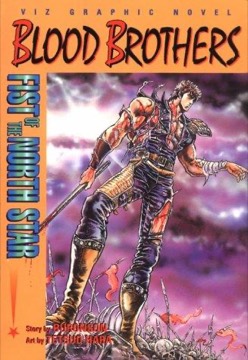
Fist of the North Star
Buronson and Tetsuo Hara's series, begun in 1983, set after a nuclear war, following a martial artist whose technique destroys opponents from within. The template for the action manga that followed.
- First published
- 1983
- Publisher
- VIZ Media LLC
- Pages
- 200
- Shelf
- Anime
- Level
- Entry
- ISBN-13
- 9781569312582
Record checked against
Catalogue note
- Reads as
- ReflectiveChanges how you see rather than what you do.
- Level
- Accessible / FoundationalNo prior reading assumed.
- Approach
- Theoretical
- Written for
- Readers of comics, and anyone curious how the form works, Newcomers to the subject
Saved in this browser only — no account, nothing sent anywhere. My library
Read this if
- You read for the writing as much as for the argument.
- You want a thought experiment you can live inside for a while.
- You want a book that changes how you see things rather than what you do tomorrow.
- You are starting from scratch here and want a way in that assumes no prior reading.
What it is
After a nuclear war, survivors compete for water and food across a desert landscape controlled by gangs. Kenshiro is the successor to Hokuto Shinken, an assassination art that attacks pressure points and kills from inside the body.
He travels, encounters a local tyranny, destroys it, and moves on, with a longer narrative about his rivals and his lost fiancée running underneath.
A wandering martial artist, a ruined world, and one town's warlord per arc.
Devmark’s reading — not a quotation from the book
The formula it established
The series set the template for decades of action manga: escalating opponent strength, named techniques, rival schools, tournament structures and the constant arrival of a stronger antagonist.
Almost every long-running fighting series since — including Dragon Ball, Bleach and their descendants — is working inside conventions this one consolidated.
Hara's figures
The art is defined by enormous musculature, heavy cross-hatching and a willingness to hold on a single figure across an entire page.
The style is closer to Frank Frazetta and to 1980s action cinema than to anything in the Tezuka line, and its physicality is the series' immediate appeal.
Violence as spectacle
Opponents swell and burst, and the series' catchphrase — informing a man that he is already dead — is delivered moments before the delayed effect arrives.
The device is genuinely clever as a piece of dramatic construction: it converts the kill into a short countdown and gives the victim time to register it.
Its sources
The debt to Mad Max 2 is direct and acknowledged, and Bruce Lee's physical presence shaped Kenshiro's design and posture.
The series is a synthesis of Western post-apocalyptic cinema and Hong Kong martial arts film, filtered through a weekly Japanese boys' magazine, and the combination was new.
Sentiment
Beneath the spectacle the series is extremely sentimental about loyalty, brotherhood and the protection of the weak, and it stops for grief regularly.
The emotional register is broad and unembarrassed. Characters weep openly, speeches are made, and the series treats these as the point rather than as interruptions to the fighting.
Structure
It is arranged in arcs, each introducing a stronger antagonist with a connection to Kenshiro's own school or family, and the pattern repeats with escalating stakes.
The first half is considerably tighter than the second, which extends the formula well past the point where the escalation retains meaning.
The brothers
The rivalry among the four successors of Hokuto Shinken supplies the series' best material, particularly Raoh, whose commitment to rule by strength is given a genuine argument rather than dismissed.
Antagonists here are frequently allowed dignity and coherent positions, which is part of why the series has lasted.
Cultural reach
Its catchphrases, character designs and specific panels are among the most widely recognised in Japanese popular culture, and the series is quoted, parodied and referenced constantly.
Outside Japan it is less read than its influence would suggest, and many readers encounter it first through the works it shaped.
What has dated
The gender roles are thin, the female characters largely exist to be protected, and the plotting becomes mechanical in the later arcs.
The series is a product of a specific magazine's demands in the 1980s, and it shows. Its virtues are physical and emotional rather than structural.
Editions
English publication has been intermittent and incomplete for long stretches. A hardcover series has since reissued it in large format with the original colour pages restored, which is the version worth having if the series is being read rather than sampled.
The larger format serves Hara's art considerably better, since the detail in the cross-hatching is lost at small reproduction.
Who it is for
Readers who want to understand where modern action manga came from, and readers who simply want the form at its most physically committed.
It is not subtle and does not attempt to be. Its ambitions are spectacle, loyalty and grief, and it delivers all three at considerable volume.
What to take away
- 01The template consolidatedEscalating opponents, named techniques and rival schools became the shape of action manga largely through this series.
- 02A kill with a countdownTelling a man he is already dead converts the strike into a short delay, giving the victim time to register it.
- 03A synthesis that was newPost-apocalyptic Western cinema and Hong Kong martial arts film, combined in a Japanese weekly for boys.
- 04Antagonists with argumentsRivals like Raoh are given coherent positions rather than dismissed, which is why the series has lasted.
- 05Unembarrassed sentimentBeneath the spectacle it stops constantly for grief and loyalty, and treats those as the point.
- 06Physical rather than structural virtuesThe plotting becomes mechanical and the gender roles are thin; the appeal is the drawing and the emotion.